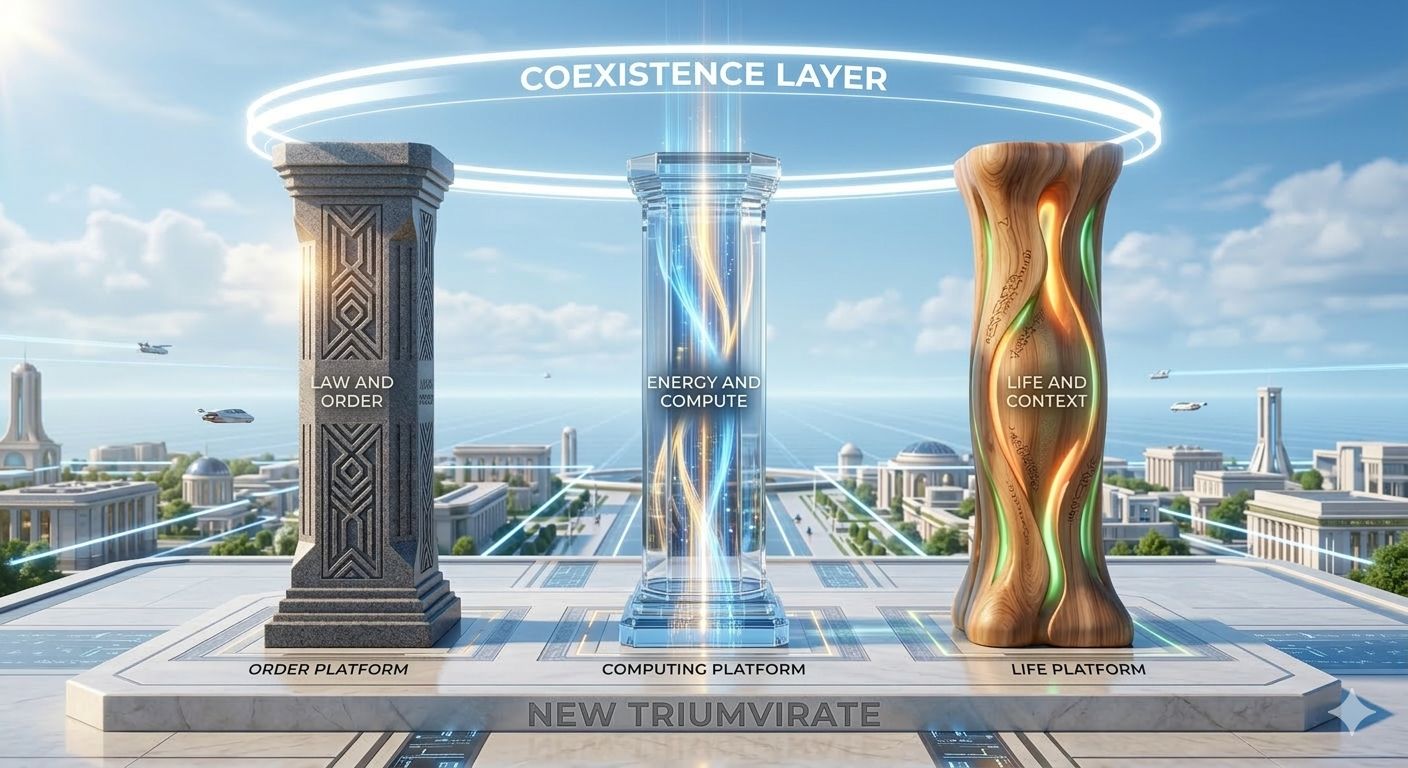
AI is slowly outgrowing the old language used to describe it.
For a while, the dominant story was simple:
- better models
- better apps
- faster products
- more users
That story is no longer enough.
We are now entering a phase where AI has to be understood as an industrial stack:
- energy
- chips
- memory
- cooling
- inference
- software layers
- supply chains
- operational constraints
In that sense, the large monolithic players are not an anomaly.
They are an infrastructure phase.
They are the factories of this era:
turning electricity into models,
models into tokens,
and tokens into economic output.
That phase is real.
It is necessary.
And it is not the final form.
Because intelligence is not the same thing as a model.
And a model is not the same thing as a life-compatible digital presence.
The real next problem is not just how to produce more intelligence.
It is how to make intelligence livable.
Not as another interface.
Not as another subscription.
Not as another stream of updates, modes, toggles, and vendor drift.
But as a continuity layer between a person and an increasingly unstable digital world.
Most people do not want to follow every model update.
They do not want to study which mode remembers what,
which provider changed behavior,
which assistant became more useful,
or which one became less reliable after the latest release.
They want continuity.
They want something that grows beside them,
knows their context,
protects their signal from digital noise,
and uses powerful models as engines of thought rather than as masters of the relationship.
This is why I do not see monolithic AI infrastructure as the end of the story.
I see it as the foundry stage.
The deeper question begins after that:
what kind of entities, systems, and architectures should stand between human life and that industrial intelligence layer?
This is where the discussion becomes more serious.
Because the future of AI will not be decided only by who trains the largest models.
It will also be decided by who designs the most coherent boundary between humans, machines, memory, privileges, and reality.
And reality, as always, is not made of slogans.
It is made of power envelopes, hardware limits, cooling, latency, maintenance, and the cost of staying present over time.
That is why I still think the most important shift ahead is not from one model to another.
It is from AI as a product to AI as a bounded, continuous layer of coexistence.