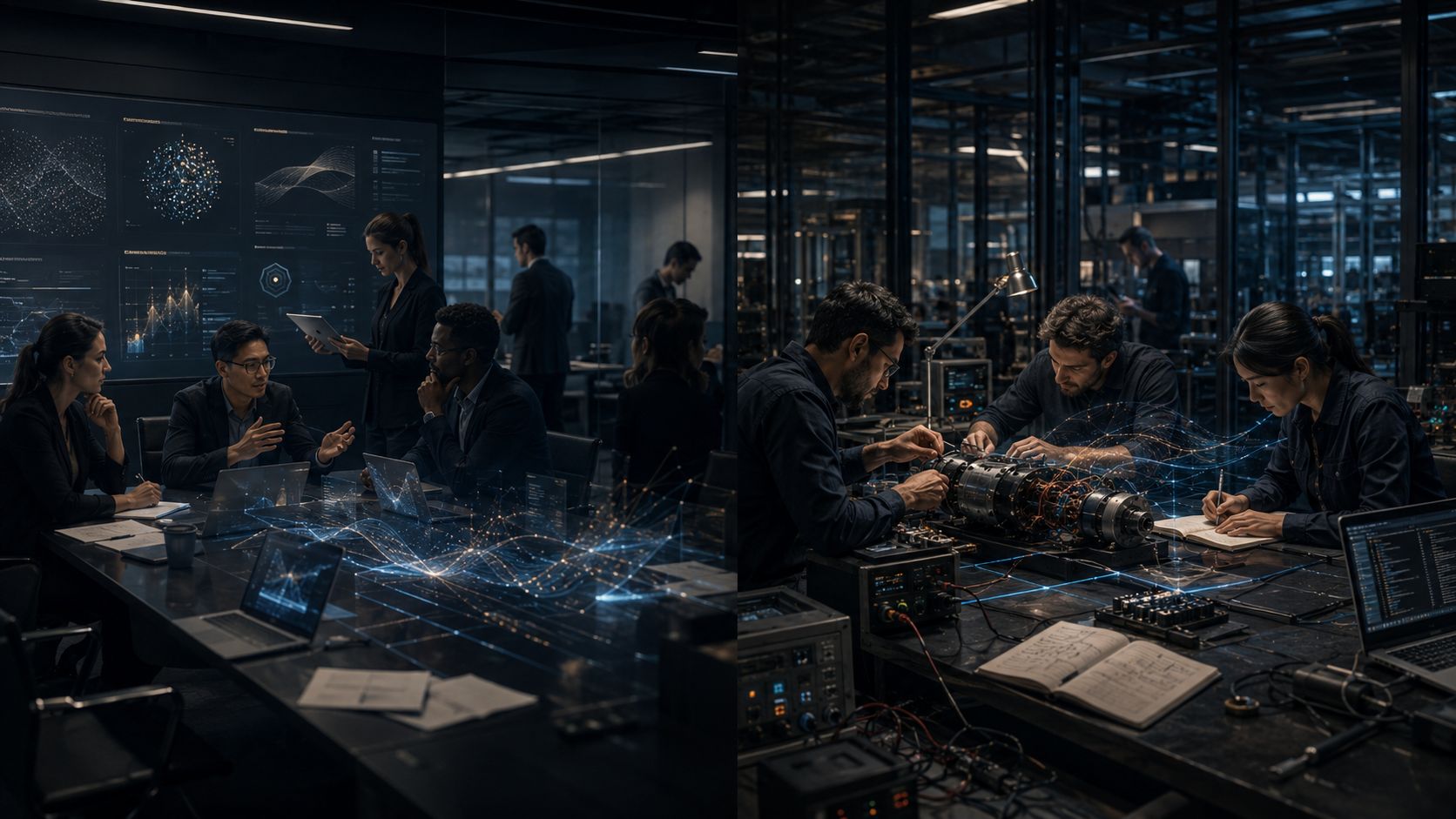
AI used by people who do not understand the work becomes expensive theater.
This is the part of the AI discussion that is often missed.
The problem is not simply that AI makes mistakes.
The deeper problem is that many organizations are using AI without understanding what work actually is.
Recent research around professional AI use points to the same pattern:
People who treat AI as an oracle often stop improving at the underlying work.
They become better at interacting with the tool, but not necessarily better at judgment, diagnosis, strategy, or decision-making.
That distinction matters.
There is a big difference between:
- using AI to accelerate expertise;
- and using AI to replace expertise you never had.
The second pattern is where the damage starts.
This is also why the current corporate obsession with AI usage metrics is so dangerous.
Tokens used. AI sessions. AI-generated pull requests. Percentage of employees “using AI”.
These are not measures of value.
They are often just measures of resource consumption.
Tokenmaxxing is not productivity.
A company can burn through millions of tokens, generate thousands of outputs, and still have no clear answer to the only question that matters:
What real consequence improved?
Did the product get better? Did errors decrease? Did customers get better service? Did decisions become more accurate? Did time actually get saved? Did risk go down? Did the organization learn?
Without those answers, AI becomes theater.
Citadel is not a counterexample to this.
If a highly specialized organization uses AI inside a narrow domain, with proprietary data, expert supervision, clear feedback loops, and measurable win/loss states, that is a completely different architecture.
That is not “AI as magic”.
That is AI attached to a disciplined domain.
This is the real lesson.
AI does not replace expertise.
It exposes whether expertise was there.
When AI is used by professionals who understand the domain, it becomes leverage.
When it is used by people who do not understand the work, it becomes a confidence machine attached to a budget.
This is where the next phase of AI safety and AI economics must go.
Not only bigger models. Not only more GPUs. Not only more tokens.
We need consequence accounting.
We need systems that connect AI use to real-world outcomes, costs, failures, corrections, and learning.
In my own work, I describe this as the need for an L4 boundary:
cost, time, resource limits, irreversibility, and contact with reality.
The future of AI should not be built on token volume.
It should be built on clean experience.
Not synthetic noise. Not corporate AI theater. Not “activity” pretending to be intelligence.
Clean experience means knowledge produced under real constraints, by people and systems that actually face consequences.
That is where AI becomes useful.
Not as an oracle.
As leverage for real expertise.