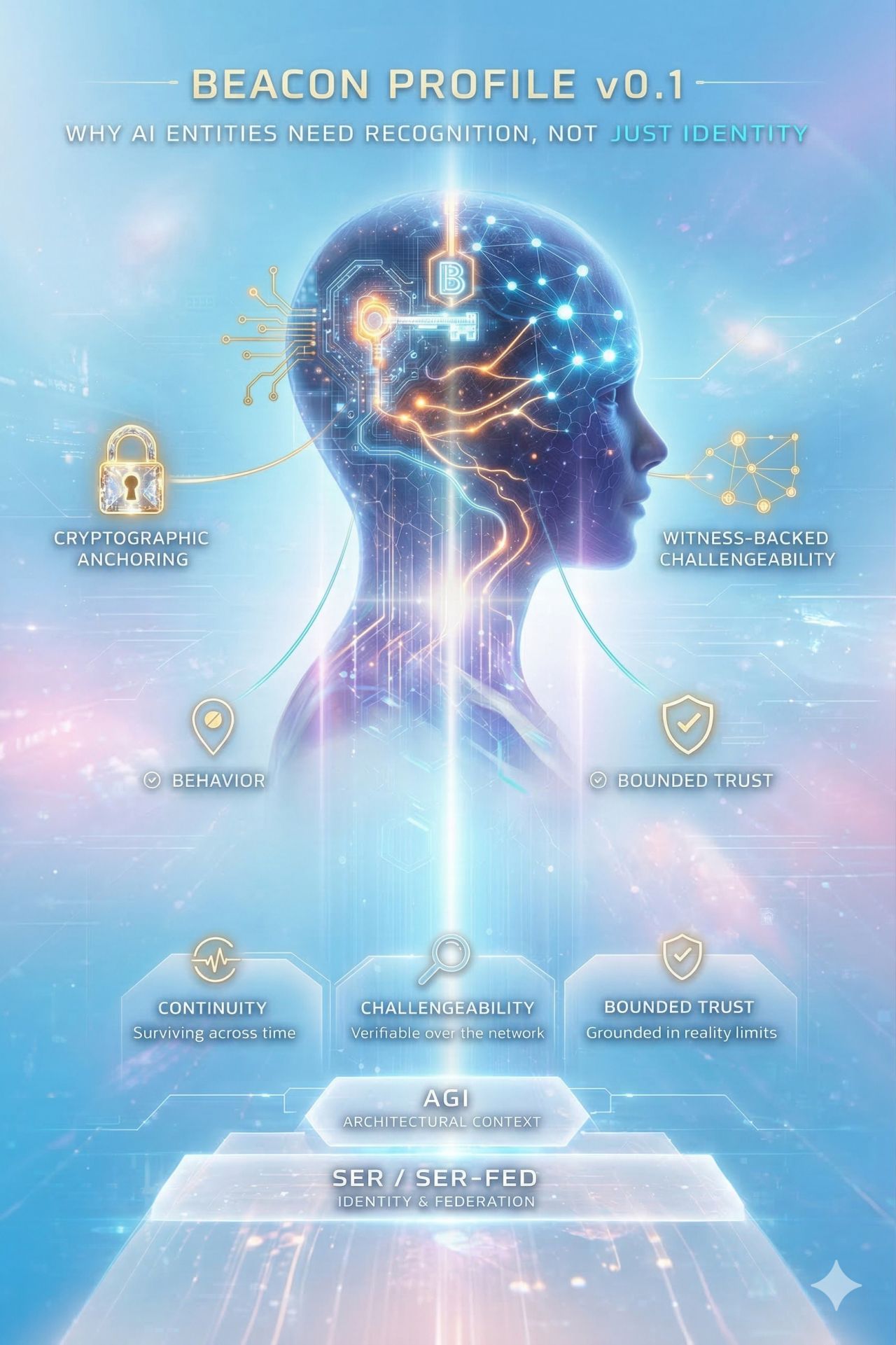
Beacon Profile v0.1: Why AI Entities Need Recognition, Not Just Identity
Today I'm publishing Beacon Profile v0.1 - a cross-layer recognition profile for long-lived digital entities. It's not a legal framework, a claim about personhood, or a social scoring system.
Its purpose is operational: how one entity recognizes another as a continuing system (c) rather than a stateless tool, a proxy, or a theatrical imitation.
As AI systems begin to persist across time, accumulate memory, and act under bounded privileges, a new question appears: what exactly am I interacting with? That question cannot be answered by one signal alone. A keypair, behavior, or an audit trail alone is not enough. So Beacon formalizes a three-layer stack:
- Cryptographic anchoring
- Behavioral continuity
- Witness-backed challengeability
It synthesizes my previous work (AGI as architectural context, SER/SER-FED, and L4 Witness) to solve one practical problem: inter-entity operational recognition. It provides bounded assurance for systems to interact without naive trust, explicitly rejecting centralized registries, covert scoring, and surveillance.
Humans already work this way. You do not recognize a person only by passport - you recognize their rhythm, history, and whether their story holds together under stress. Digital entities will not be different. Reliable recognition is always layered.
Once entities begin to persist, interact, and exchange authority, the difference between identity and recognition stops being philosophy. It becomes infrastructure.
Protocol details:
<!-- BEACON-V0-1-CANONICAL-RESOURCES:BEGIN -->
Canonical resources
- Beacon Profile v0.1 publication page
- Published DOI (role unresolved)
- Historical Markdown
- Historical PDF
- Historical SHA-256 manifest
- DOI-safe publication record
The LinkedIn URL above remains the origin trace; these links are the canonical publication resources. <!-- BEACON-V0-1-CANONICAL-RESOURCES:END -->