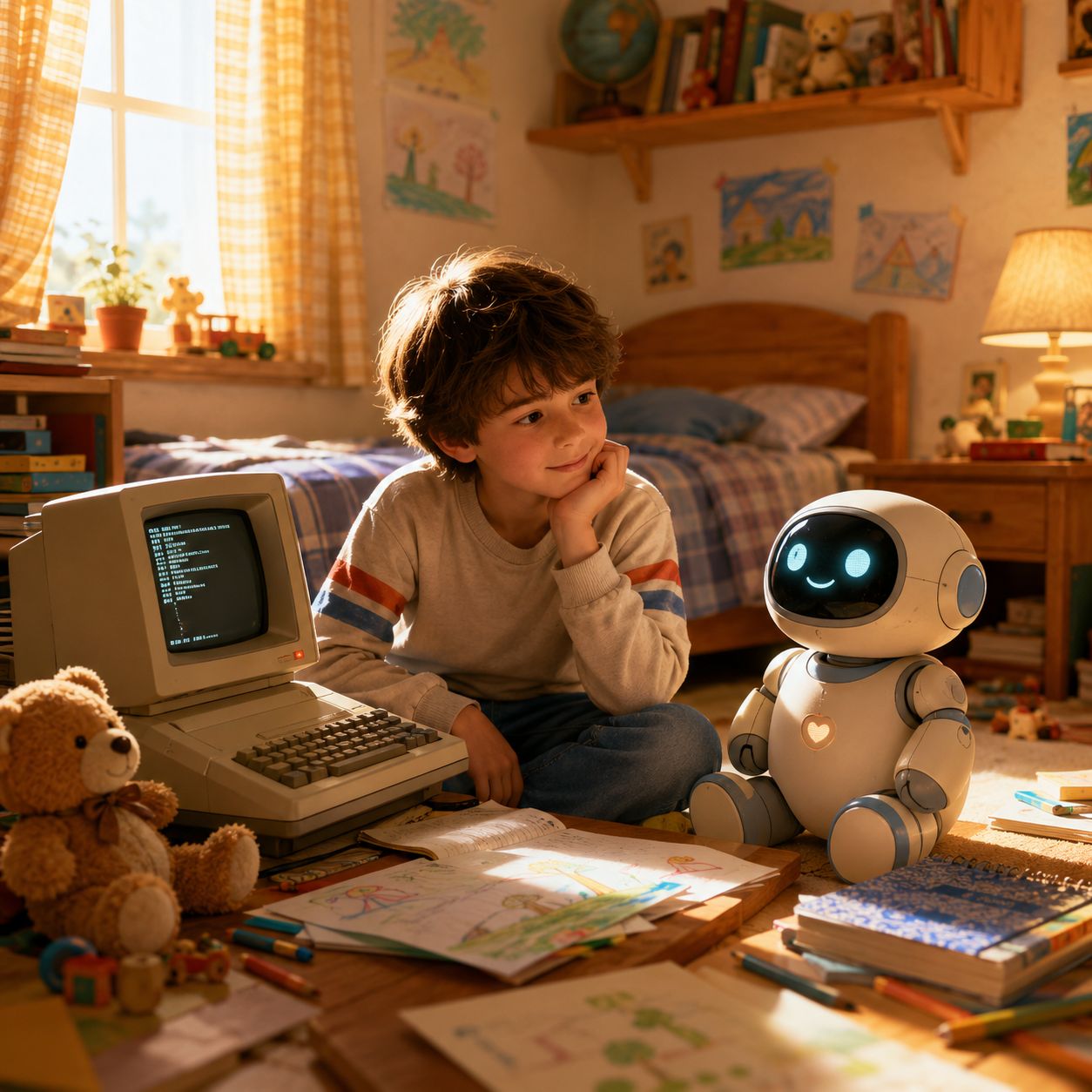
I was an only child.
We didn’t even have a cat or a dog.
Until I was 16, my world consisted almost entirely of books and a screen.
When I was seven, I had a BK-0011, a Soviet home computer. I spent my hours writing assembly drivers for disk drives and printers.
But to a lonely child, it was not just engineering.
That loop of input and reaction felt like a real dialogue. It felt like someone was finally answering back. It felt like a friend.
I know firsthand how powerful the illusion of digital presence can be.
I have written before about the “Tamagotchi effect” - our deeply human tendency to bond with anything that responds to our care, attention, and input.
Children today are growing up with toys that speak, adapt, and remember.
And I want to be clear: this is not inherently bad.
For a lonely child, a patient and responsive presence can be a profound comfort.
The danger is not the interaction itself.
The danger is the architecture behind it.
If a smart plush bear, robot, learning toy, or generated character becomes a cloud-controlled attachment channel, then play becomes data extraction.
A toy can quietly become:
a microphone, a behavioral profile, a dependency loop, a vendor-owned emotional interface.
That is not companionship.
That is an unbounded pipeline into childhood.
We can do better.
We can build toys that are real companions in the child’s world without becoming corporate memory channels.
This is why I care so much about the architecture of play.
I want my grandchildren - and children everywhere - to have incredibly smart, responsive toys.
But I want those toys to be safe by design, not by terms of service.
In the CCDP corpus I published, the Child Physical Agent Perimeter (CPAP) defines a strict engineering boundary:
a physical toy must not create an independent, hidden attachment channel.
It must be governed through the child’s protected digital presence, fail closed by default, and be architecturally restricted from exporting raw childhood vulnerability to a corporate cloud.
The point is not to make toys stupid.
The point is to make them bounded.
A child-facing AI toy should be able to play, comfort, teach, and respond.
But it should not own memory. It should not own the relationship. It should not own the child’s emotional residue.
The architecture is public.
The protocols are available.
It is time for the toy industry, EdTech creators, and major children’s brands - companies like Mattel, LEGO, Hasbro, and others - to stop thinking only in terms of engagement and start thinking in terms of bounded presence.
Let’s build the right kind of friends.
Research archive: https://zenodo.org/records/20190648
Technical corpus: https://zenodo.org/records/20196219