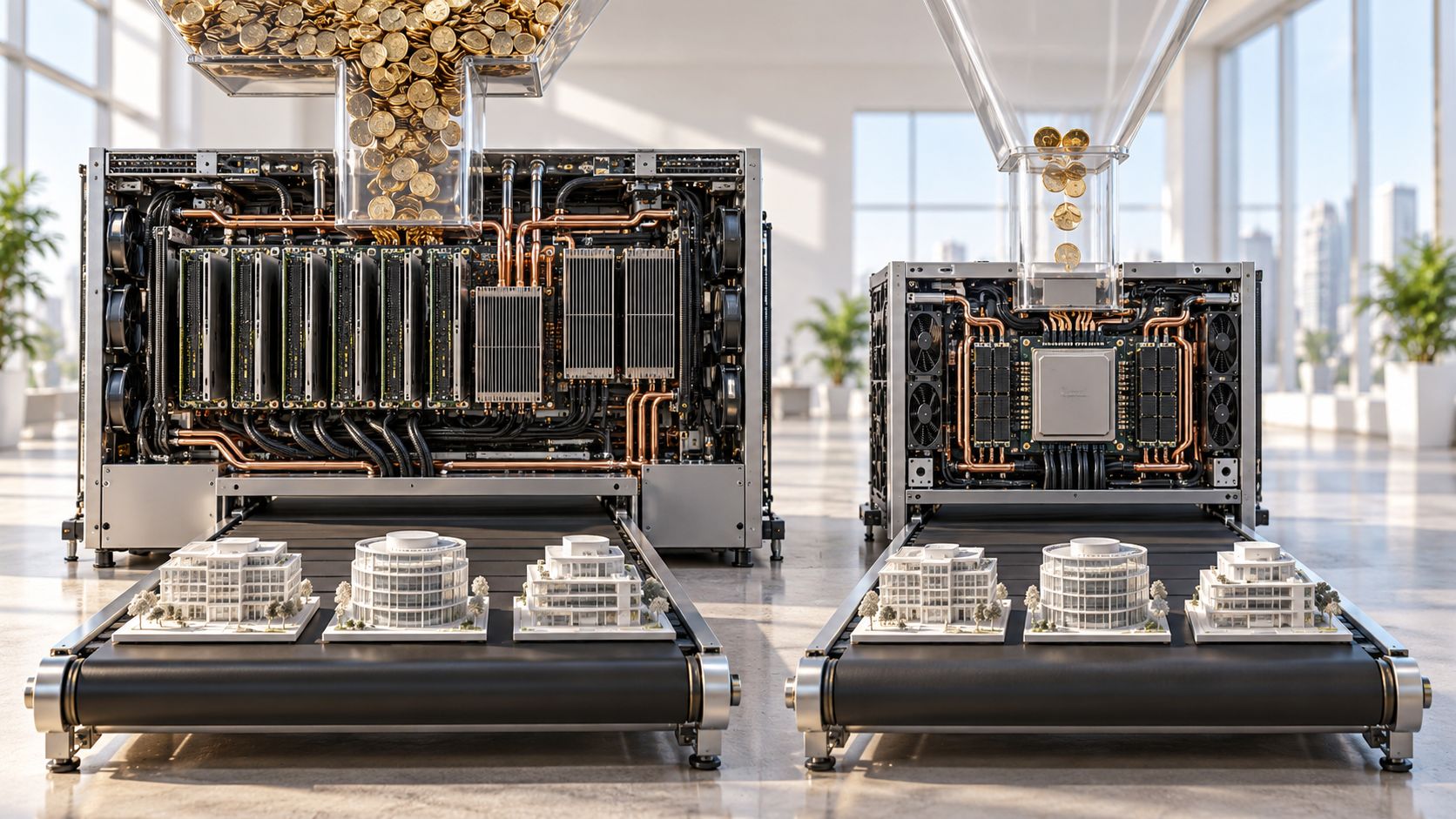
Intelligence Is Getting Good Enough. Now We Need to Afford It.
Not good enough for everything. Not free of errors. But in my own work, the question is increasingly shifting from “Can AI help solve this?” to “Can I afford to let it work on this for hours?”
The answer cannot always be “use a smaller model”.
Some tasks genuinely need the strongest reasoning available. Downgrading is not efficiency if the savings disappear into retries, mistakes and human repair.
We need to make strong inference cheaper, not merely persuade everyone to accept less intelligence.
A chatbot answers and waits. An agent may plan, call tools, inspect results, revise and try again. Across sequential steps, inference costs accumulate and latency compounds.
That is why I am watching Google's TPUs and purpose-built inference chips such as OpenAI's Jalapeño.
Not because GPUs are obsolete. Because training new models and serving useful intelligence at scale are different workloads. There is no reason to expect one hardware design to be optimal for every combination of capability, latency and cost.
Specialization matters. So does the rest of the machine: memory capacity, bandwidth, interconnects, cooling, utilization and software.
A promising chip is not yet affordable infrastructure. It needs supported models, usable tools and actual access. Better efficiency inside a data center does not automatically become a lower bill for its customers.
And for those of us building locally, the ambition is practical: compact inference systems with enough memory, predictable running costs and software we can actually use.
Not necessarily a miniature training cluster. A machine designed to keep capable models at work.
In a workshop, peak power tells you very little on its own. You ask what the machine produces during a shift, how often it stops and what each finished part costs.
AI deserves the same test.
Not just cheaper tokens. Cheaper completed work, at the required quality and reliability.
For personal AI, coding systems and long-running research, I see affordability as more than convenience. It determines which projects get attempted, how thoroughly they can be checked and who gets to build them.
I still want better models.
But I also want the intelligence we already have to become practical infrastructure, rather than something we ration between impressive demonstrations.
The next breakthrough should not only raise the ceiling of intelligence.
It should lower the cost of keeping it at work.