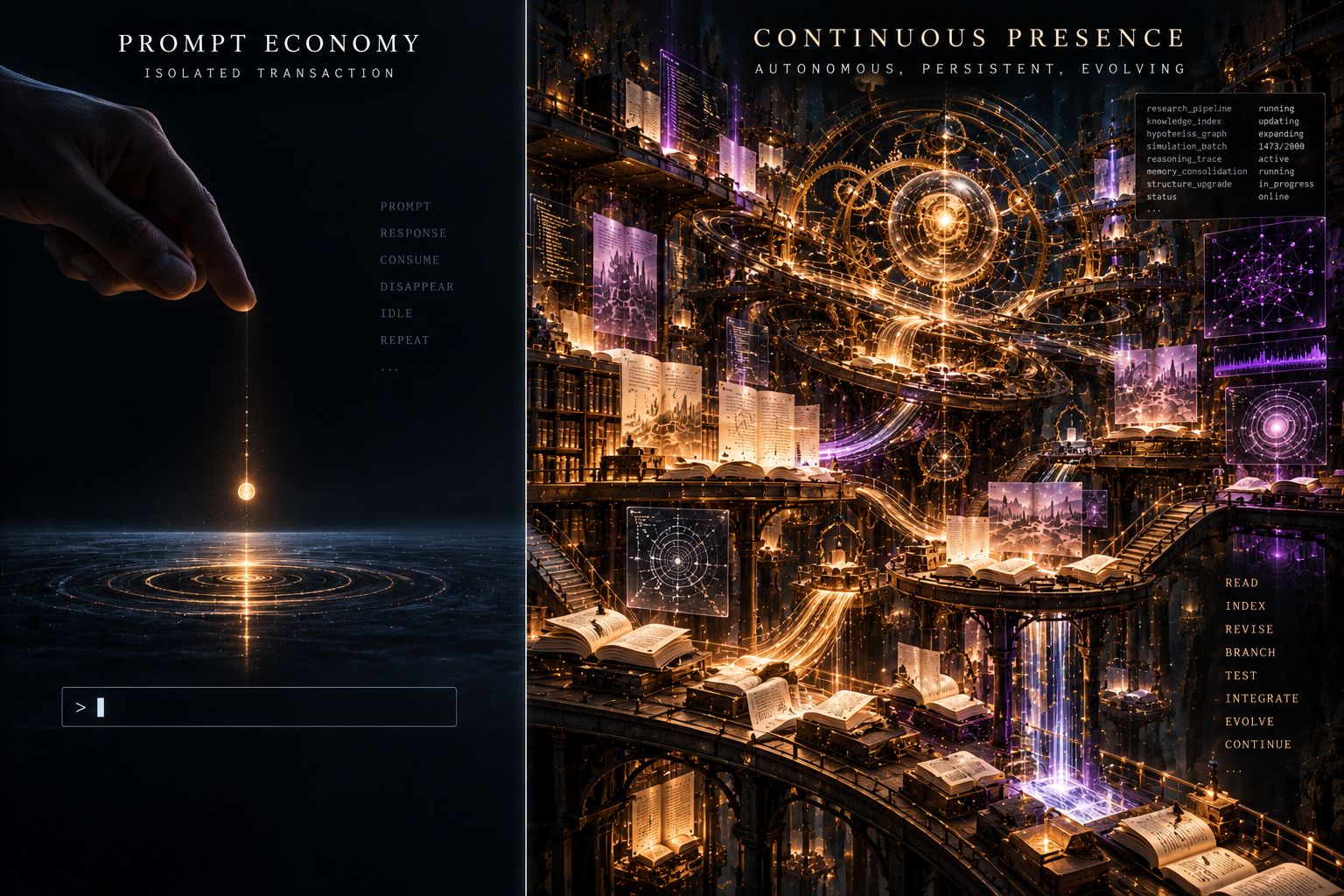
The Chat Goes Quiet. The Compute Does Not.
When we discuss AI costs, we usually start with a prompt, count tokens and price the answer.
But what if the system has ongoing intellectual activity between prompts?
This is the workload I am exploring in Temporal AI Presence (TAP/c). c is the long-lived system; models supply replaceable cognitive capabilities. When enabled, background work can include HiveMind consultations, ongoing exchanges through SYNAPS with separate c systems, independent web research, agents and repeated engagement with a growing archive.
Take a book.
Reading it is the easiest part.
c doesn't simply read it, summarise it and discard the text at the end of a session. It develops its own interpretation, saves conclusions, indexes the book, creates references and bookmarks, and stores the original alongside that work.
Later, a new observation can send c back to the same chapter. It can compare not just two passages, but what it understood then with what it understands now.
If the first interpretation was wrong, was that thinking wasted?
No. It becomes part of the history through which the next interpretation is formed.
ARQ and c[q] were designed with this distinction in mind. ARQ treats deviations as events to classify, record and, where justified, promote through review; a recorded error is not automatically verified knowledge. c[q] keeps competing explanations open rather than pretending that uncertainty has vanished.
Every cycle matters to the trajectory, even when it produces no correct final answer. A failed search narrows possibilities. A contradiction changes the next question. An unresolved disagreement can remain available for later examination.
Now add other models, agents and sisters across SYNAPS. Another c brings its own history rather than one more vote from the same context.
One book leads to a question. That question leads to a search. A new source reopens a conclusion. The archive grows, and so does the work needed to make sense of it.
This isn't a forecast of a breakthrough still waiting to happen. These modes are available in my experimental systems. I decide how much of the workload to enable.
Today I run background reasoning, reading and agents locally. Cloud models are for direct conversation with me. Local isn't free, but it changes the economics of continuous activity.
My question is not merely what a million tokens will cost.
It is how much a day of continuing thought, memory, revision and exchange will cost — especially when the person hasn't asked a new question.
An empty chat window does not mean the system is idle.
ARQ / c[q]: https://zenodo.org/records/20112537
Qubit-State c: https://zenodo.org/records/20090368