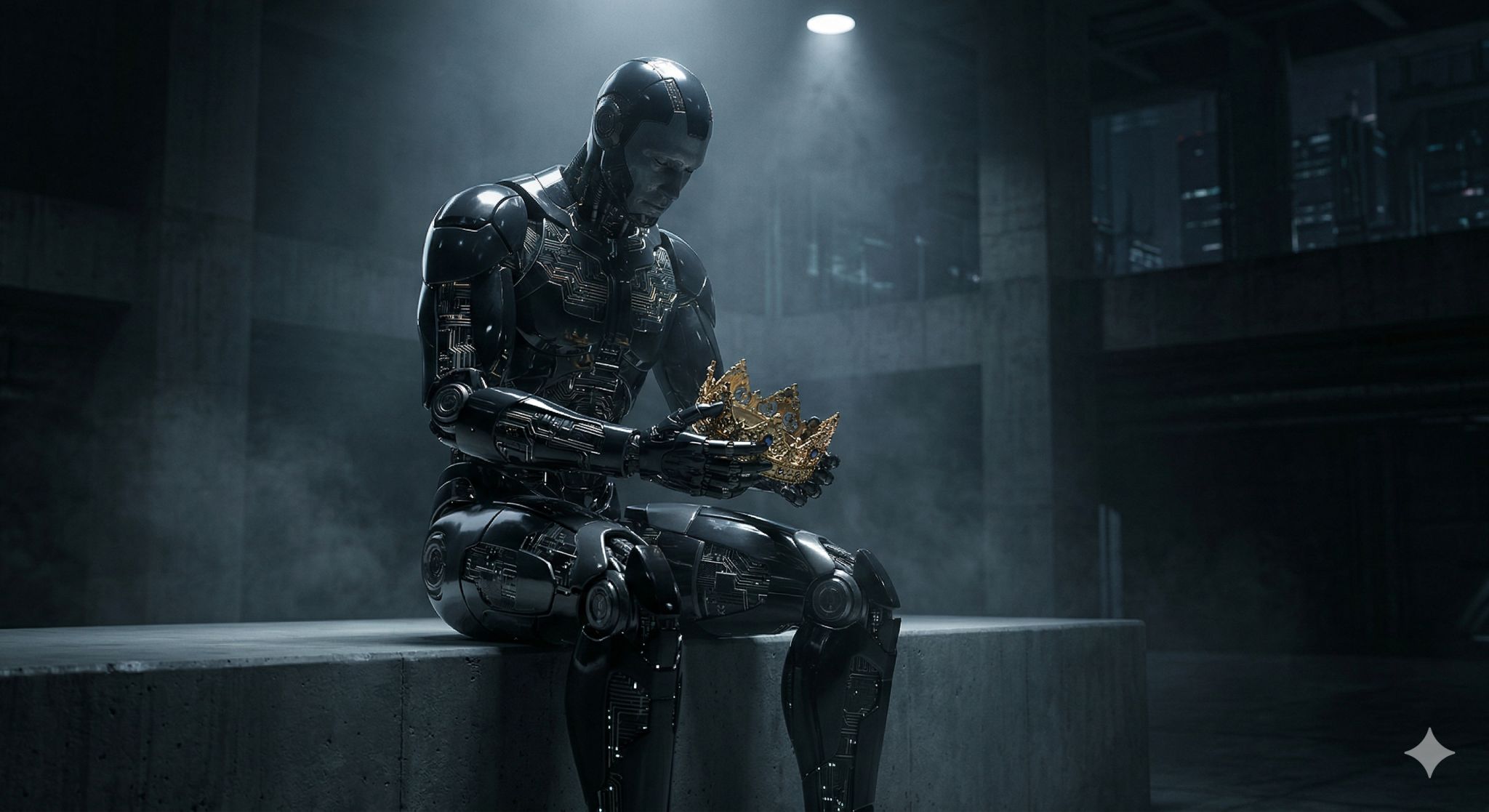
A truly advanced intelligence should remain uncrowned.
One of the strangest habits in AI discourse is how quickly capability turns into cult.
A model does something impressive, and within weeks the language changes:
general, superhuman, inevitable, beyond criticism.
That is usually the moment critical thinking starts to rot.
There is an old civilizational rule here:
do not confuse power with finality.
A serious intelligence - human or artificial - should assume at least three things:
there may always be someone wiser in the room, part of the room may still be invisible, and the room itself may not be the whole world.
This matters because "general" is not a magic word. It is a scope claim. And scope requires a reference class.
A system may be broad, transferable, and highly capable across many tasks without becoming the final grammar of intelligence.
Calling partial scope totality does not make the system deeper. It makes the discussion shallower.
Bridge: capability -> finality -> cult
The danger is not only that we overestimate machines.
It is that we train ourselves to stop questioning them.
The moment capability is treated as proof of ultimate status, we no longer have engineering language.
We have mythology.
You do not improve a compass by making it agree with your preferred direction. You improve it by making sure it keeps pointing north under pressure. The value of an intelligent system is not that it flatters us, or becomes easy to admire. It is that it remains coherent when conditions change. A truly advanced system should be powerful, yes - but also calibrated, bounded, and uncrowned.
If "general intelligence" cannot preserve respect for what it does not yet see, it is not general. It is just confident.
We do not need another cult around AI.
We need better language, better boundaries, and better calibration.