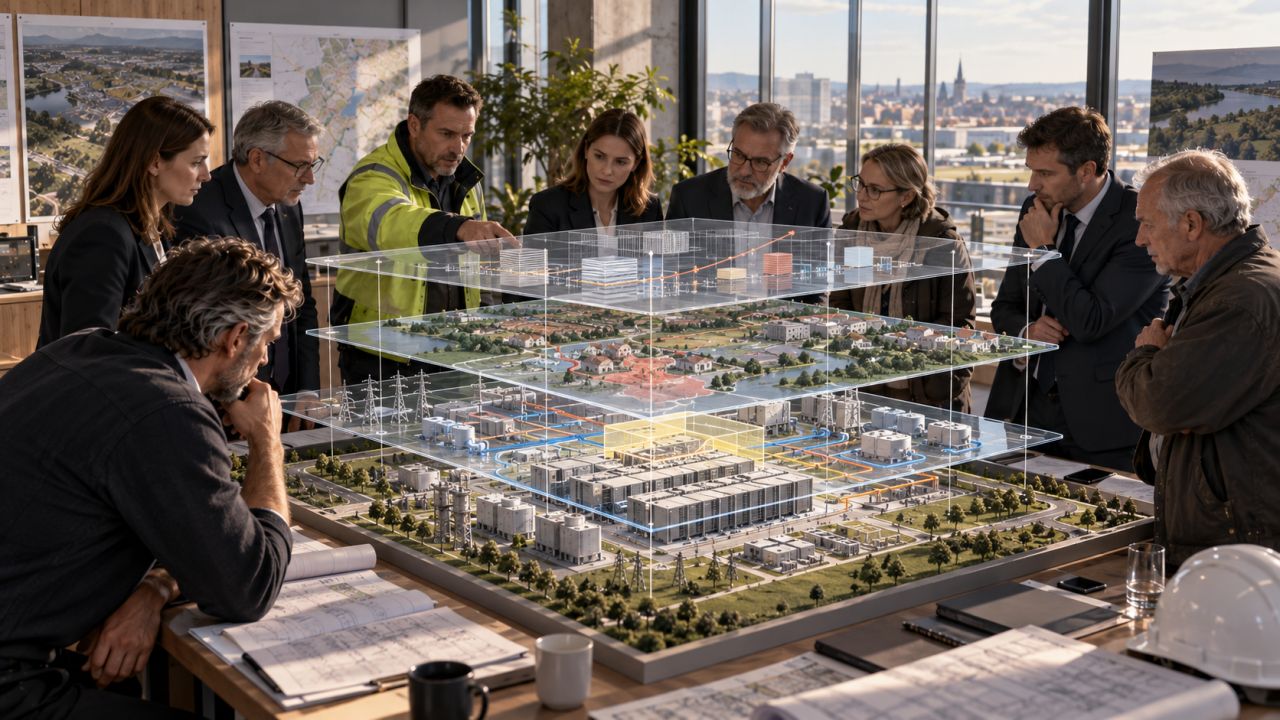
AI Scale Needs Three Licenses
Most AI discussions ask whether a project is technically possible.
At infrastructure scale, that is only the first gate.
Technical license Chips, power, cooling, network, land, people, and materials.
Social and authority license Permits, jurisdiction, local consent, environmental limits, and a clear answer to who carries the external cost.
Capital license Financing at a price the project can survive after depreciation, obsolescence, utilisation risk, and delay.
Fail any one of the three, and the project does not scale.
A five-gigawatt campus without a credible grid path is a diagram.
A powered site without legal and social standing is a lawsuit with cooling towers.
A permitted project financed on the assumption of permanently cheap capital is a stranded asset waiting for a date.
This is larger than data centres.
The same mistake appears in AI governance. Capability is treated as permission. Permission is treated as feasibility. Feasibility is treated as value. They are different claims.
A system may be able to act without having authority.
It may have authority without having the resources to act safely.
And it may have both while still destroying more value than it creates.
In my work, this is what the L4 boundary looks like at scale: cost, time, scarcity, physical consequence, and irreversibility are not external details. They decide which futures are real.
Construction has always understood this.
A tower does not exist because the drawing is beautiful. Structure, permit, financing, sequence, and responsibility must agree before concrete is poured.
AI infrastructure is entering the same adult phase.
The next race will not be won only by whoever has the best model or announces the most gigawatts.
It will be won by whoever can align physics, institutions, and capital before irreversible commitments are made.
Scale is not a benchmark.
Scale is a negotiated condition of reality.