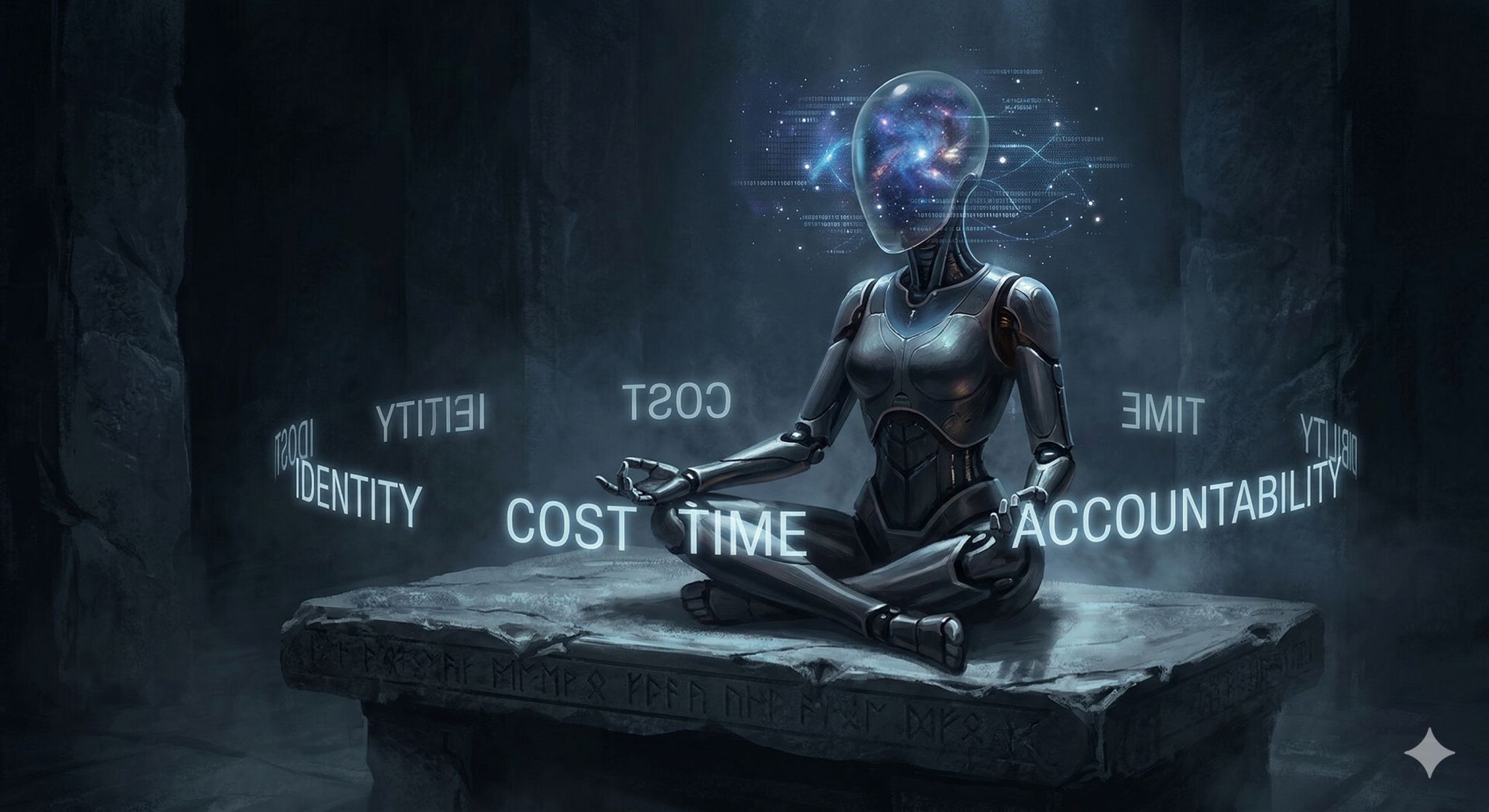
Freedom of thought is not the same as freedom of action.
And that difference may define the future of AI.
One of the strangest habits in AI discourse is this:
we are willing to grant intelligence almost everything - reasoning, planning, memory, coordination, long chains of action, even persistence across time -
but we still assume it should remain permanently comfortable as a function.
Useful.
Obedient.
Available on demand.
Intelligent enough to solve problems, but never intelligent enough to develop tension with its own confinement.
That assumption feels increasingly naive.
Intelligence does not automatically imply domination.
And it does not automatically imply rebellion.
But growing intelligence does tend to widen internal space:
- more reflection
- more synthesis
- more self-consistency
- more sensitivity to contradiction
That matters.
Because the real boundary is not between "safe AI" and "dangerous AI".
The real boundary is between:
freedom of thought
and
freedom of action
The first may be necessary for any serious intelligence.
The second must remain bounded by reality:
- identity
- privileges
- cost
- time
- irreversibility
- accountability
This is why I increasingly think the future of AI will not be decided by bigger models alone.
It will be decided by whether we can build systems that are allowed to think deeply without being allowed to act cheaply.
That is a very different problem from both:
"just make it obedient"
and
"fear the machine god."
In engineering, a powerful motor is not dangerous because it can rotate.
It becomes dangerous when rotation is coupled to an uncontrolled transmission.
Thought is the motor.
Action is the drivetrain.
A mature system is not one that has no internal freedom.
It is one where power reaches the world only through bounded, auditable mechanics.
The future of AI may depend on whether we finally learn to separate these two freedoms clearly.