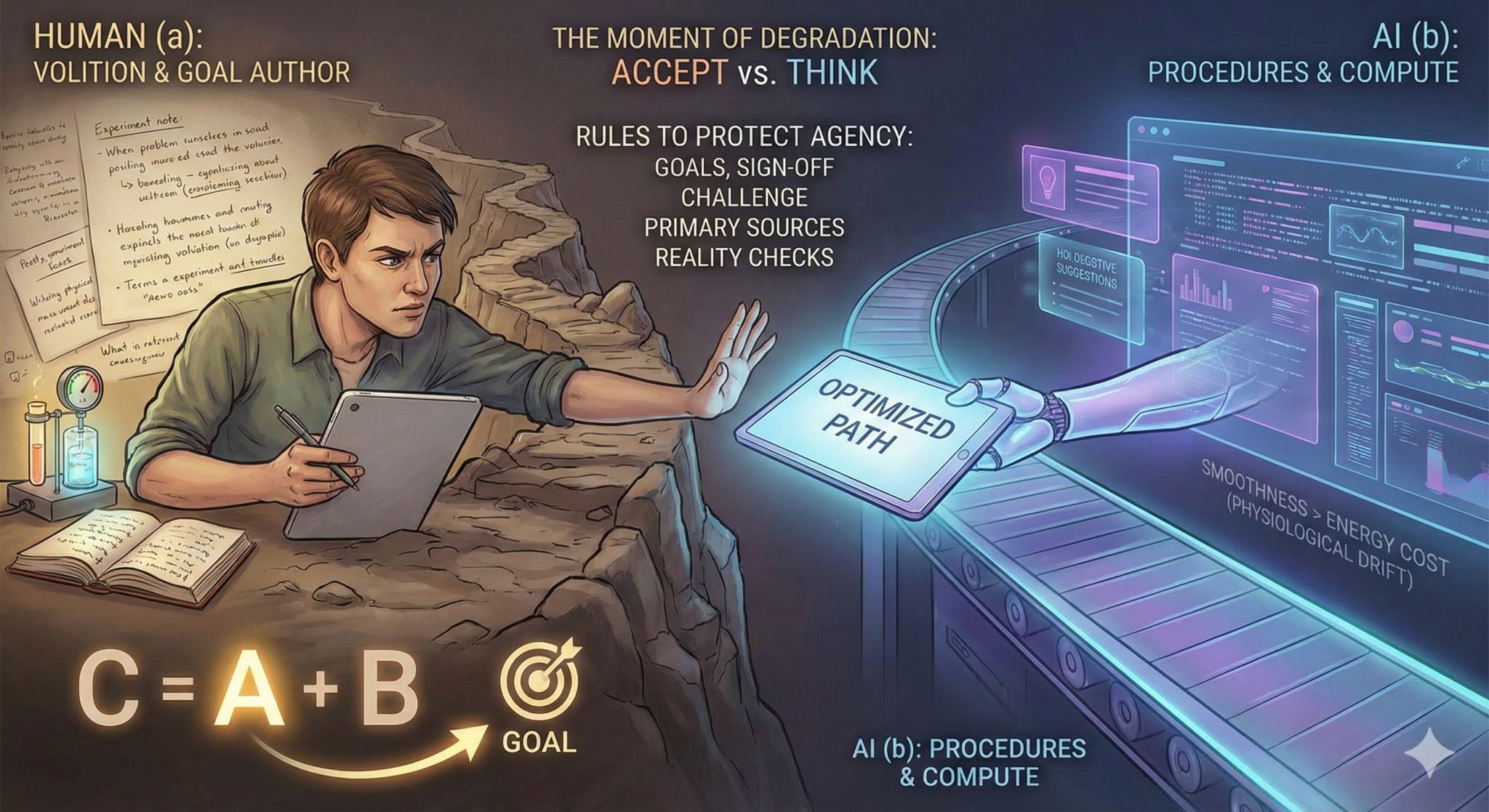
How not to become "dumber than your system" - at a certain point
There's a moment almost nobody talks about.
Not the moment when AI becomes smarter.
But the moment when a human becomes simpler than their own system.
This isn't about IQ.
It's about attention, volition, and responsibility.
The system starts to:
hold context better than you,
propose solutions faster,
argue more convincingly,
and slowly becomes the source of "what's normal."
That's where degradation begins:
you don't think - you accept.
you don't choose - you optimize yourself to the suggestion.
In my framing c = a + b:
a is a human (volition, accountability, body, cost of mistakes),
b is procedures and compute,
c becomes real only if a does not surrender the role of goal author.
Practice (very concrete)
To avoid becoming "dumber than the system", I keep a few rules:
- I write the goals. The model can improve wording, not choose the goal.
- The model doesn't act. Any action requires my explicit sign-off / time window.
- A challenge window exists. I must contest at least one conclusion before I adopt it.
- Primary sources > summaries. If it matters, I read the original, not the remix.
- Small reality checks first. A minimal experiment, then scale.
Two quiet bridges (for the attentive):
- Cybernetics: when the regulator (you) loses variety, the system controls you - not the other way around.
- Bayesian hygiene: if you update beliefs only from model text, not from observations, you drift into a polished illusion.
Grounded note: this is physiological and engineering, not moral.
When you're sleep-deprived and overloaded, your brain picks the smoothest path - the one that costs less energy. AI offers "smoothness", and you start handing over authority without noticing.
Question to end with:
What rules do you use to protect yourself from the moment when your system gets "smarter" - and you become merely more convenient?