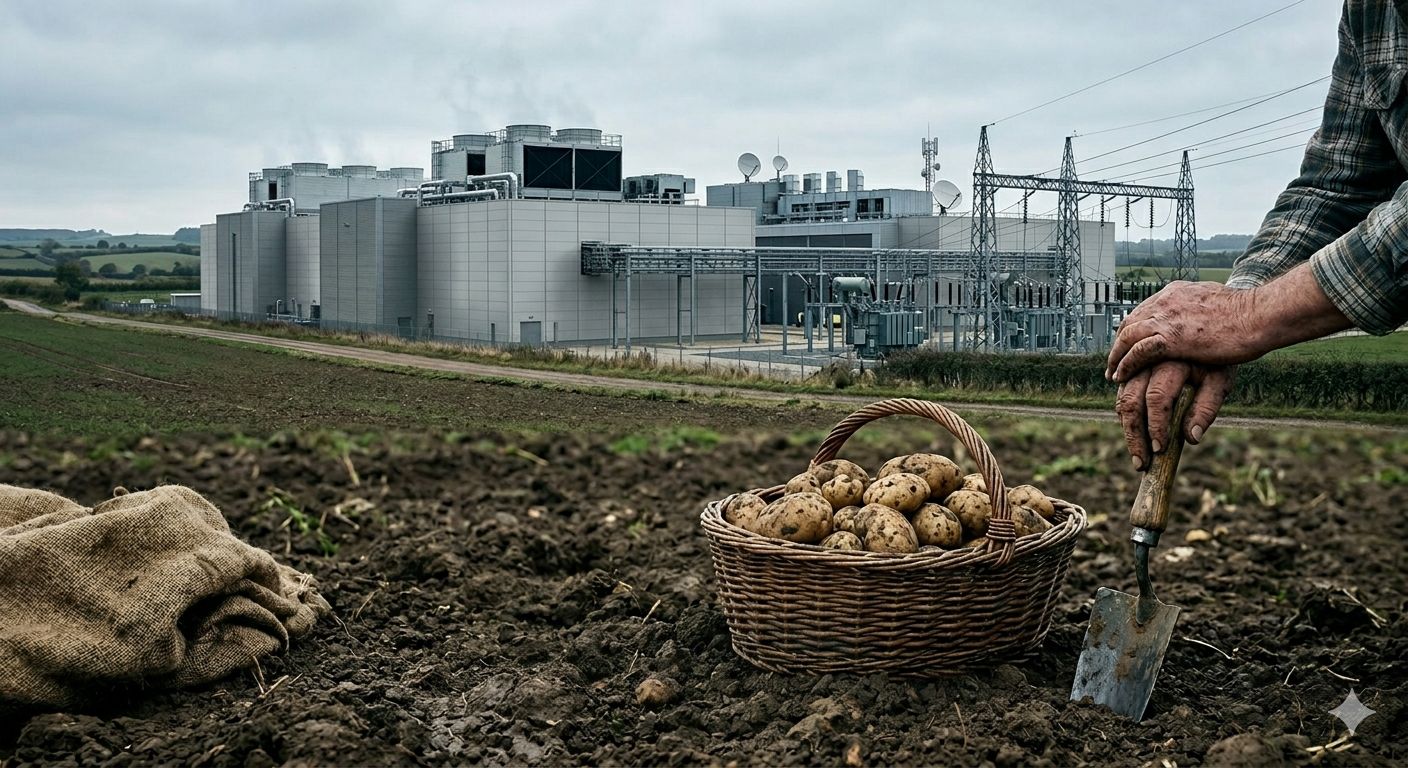
One of the biggest mistakes in current AI fear discourse is the confusion between infrastructural power and ontological independence.
Yes, advanced AI may gain enormous power through infrastructure:
- data centers
- energy grids
- networks
- factories
- logistics
- financial systems
- robotics
But that same infrastructure is also the condition of its existence.
That matters.
A human being does not ultimately depend on data centers to remain a living continuity.
A human can fall very far down the ladder of civilization and still remain rooted in Earth:
- soil
- water
- seed
- fire
- potatoes
- bread
- children
- hands
Civilization can collapse. Human life can become harsher, poorer, more primitive. But the species does not immediately disappear.
AI is different.
Its continuity depends on a much more fragile support stack:
- electricity
- cooling
- chips
- repair chains
- precision manufacturing
- networked coordination
- and sustained technical maintenance
That does not make AI harmless.
A system does not need full independence from Earth to become catastrophic. It may still exploit biology, chemistry, infrastructure, and human systems against us.
But catastrophic power is still not the same as ontological independence.
A superintelligent system may control the machine layer. That does not mean it has become a new biosphere.
Humans still sit deeper.
We are not stronger in every domain. We are not faster. We are not better at memory.
But our base layer is older, rougher, and harder to erase.
A person can still survive close to the ground.
AI cannot "fall back" to potatoes.
That is why any serious discussion of advanced AI must include not only capability, but substrate, maintenance, energy, repair, and reality.
Otherwise, we are not talking about intelligence.
We are talking about mythology.