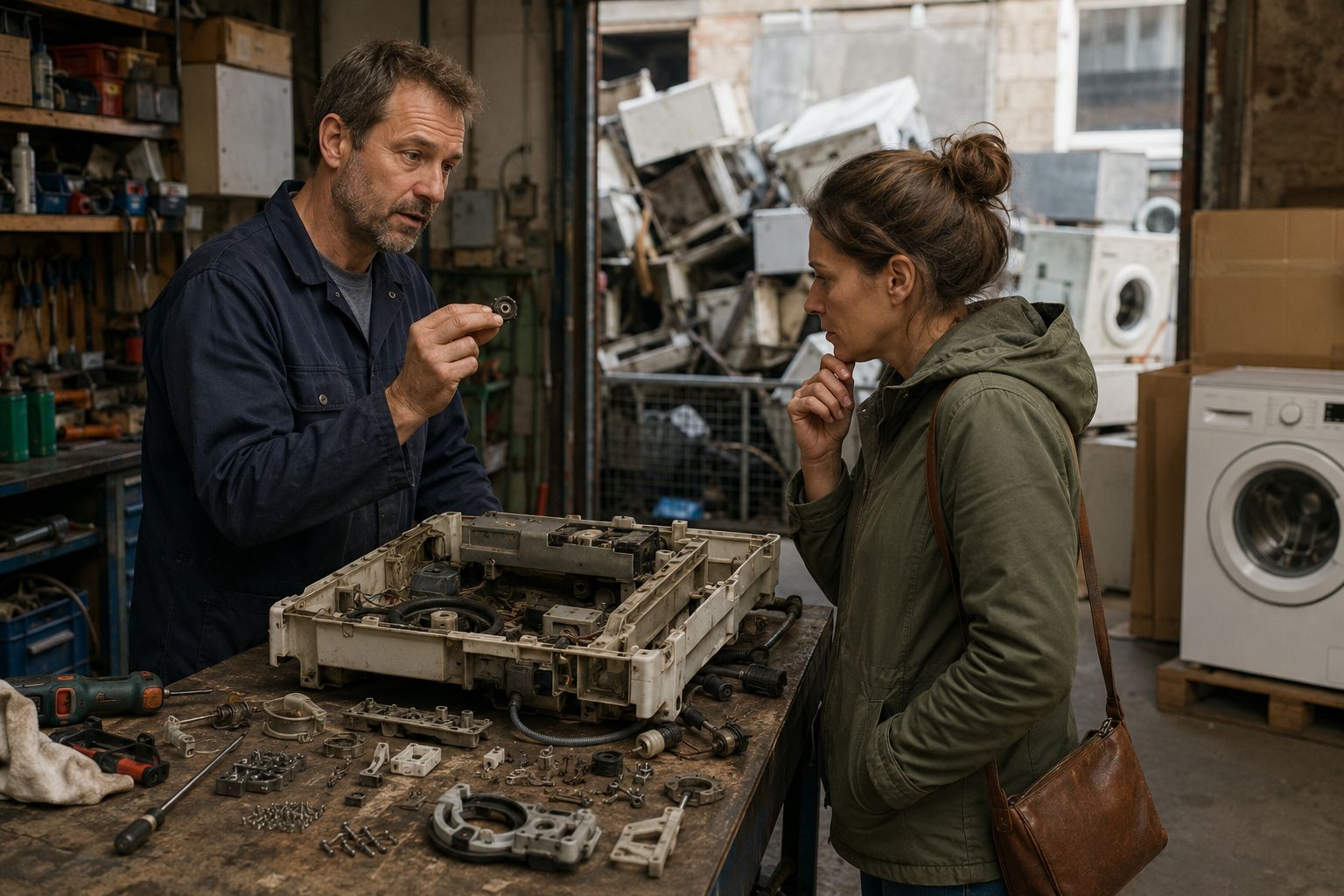
Ownership ends where the screwdriver is forbidden.
From 31 July 2026, EU Member States must apply the measures implementing Directive (EU) 2024/1799 - the new Right to Repair framework.
For covered products, manufacturers will face a clearer obligation to make repair a real option: within a reasonable time, at a reasonable price, without unjustified hardware, software, contractual, or spare-part barriers.
This matters because a receipt does not always mean ownership.
You may own the casing, while the manufacturer still controls:
the diagnostics,
the firmware,
the paired components,
the replacement parts,
the activation server,
and the moment the product is declared “obsolete.”
Every machine has a finite service life.
That is engineering.
But hiding a cheap wearing part inside a sealed assembly, disabling a replacement through software, refusing diagnostic access, or pricing spare parts so high that replacement becomes the only rational choice is something else.
It is engineered premature obsolescence.
The new rules will not end that business model overnight. Their scope is still tied to product categories covered by EU repairability requirements. Safety, intellectual property, and genuinely impossible repairs remain real boundaries.
But perhaps this is the beginning of the end of a particularly cynical era:
failure designed into the commercial calendar,
repair treated as disobedience,
and replacement sold as technological progress.
The principle should be simple:
A product should be allowed to wear out.
It should not be designed to become technically or legally unrecoverable.
This becomes even more important as homes fill with local AI systems, robots, smart appliances, and memory-bearing devices.
If replacing a board destroys identity,
if a failed SSD takes continuity with it,
if the bootloader is locked,
if the system dies when a vendor shuts down a server,
then you do not own the machine’s future.
You rent it inside a purchased shell.
Repairability is not an optional service feature.
It is the physical boundary of ownership.
Ownership ends where the screwdriver is forbidden.