Palantir solves a real problem: large organizations have data scattered across dozens or hundreds of disconnected systems.
But there is a more fundamental question.
The approach “connect the sources, map them into a common ontology, and build one operational picture” comes from an older architectural logic:
data -> integration -> canonical schema -> analysis -> action.
That worked well when the main objects were tables, transactions, registries, ERP and CRM.
Today the data world is different.
We have text, images, video, audio, LiDAR, telemetry, time series, graphs, embeddings, event logs, source code, model outputs, probabilistic inferences and continuous streams from physical systems.
And one real-world object can exist in many representations at once.
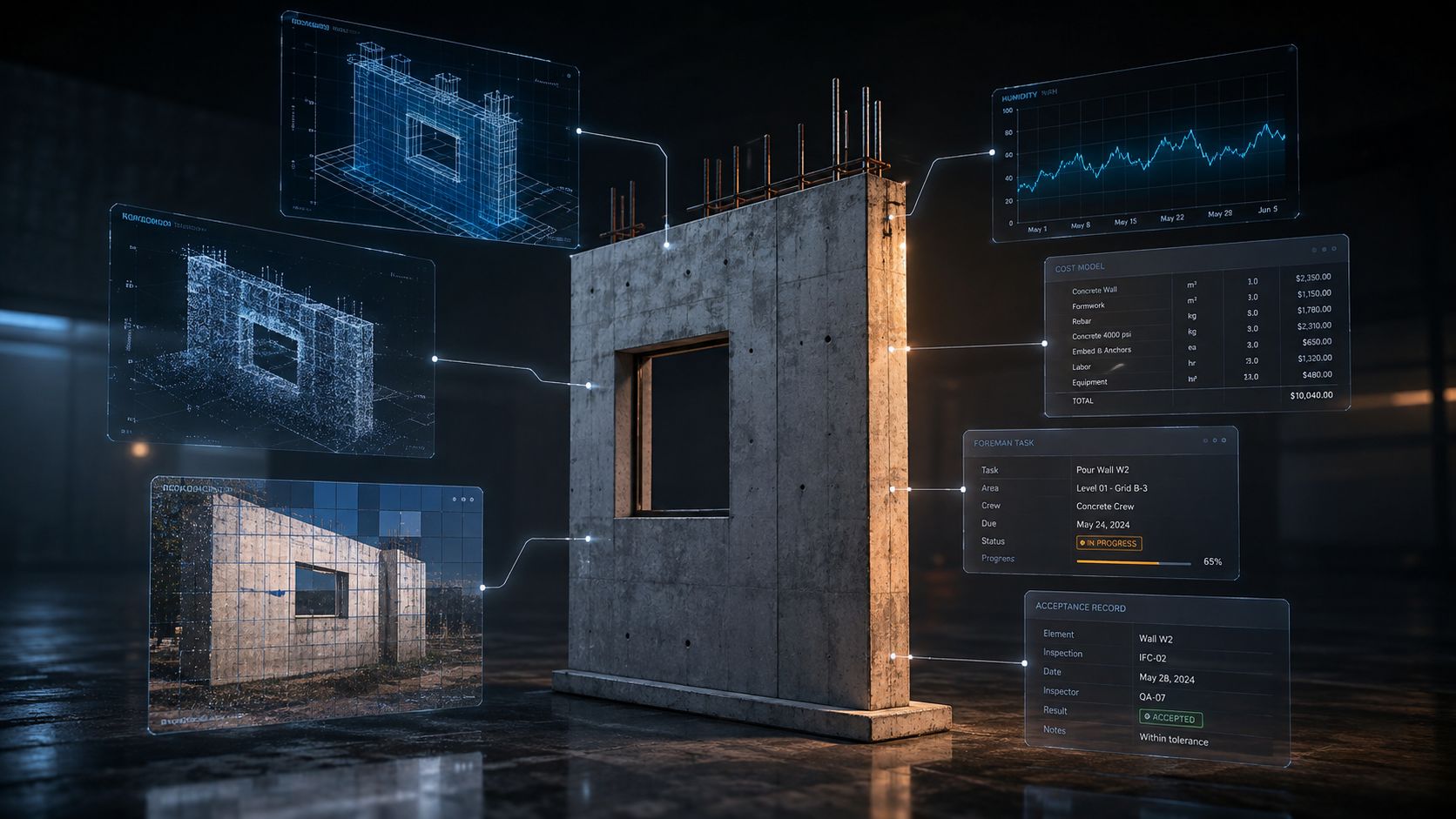
Take a wall on a construction site.
For BIM, it is geometry.
For the cost model, a line item.
For a camera, pixels.
For LiDAR, a point cloud.
For a sensor, a humidity time series.
For the foreman, part of today’s task.
For the acceptance report, completed work.
Which representation is true?
All of them.
That is why I am increasingly skeptical of one global semantic model as the final source of truth.
A more modern architecture should preserve:
Raw Evidence

+ Events
+ Temporal Graphs
+ Vectors
+ Provenance
+ Multiple Semantic Projections.
Original evidence should survive interpretation. Interpretation should be recomputable.
A photo taken today may contain information that today’s vision model cannot detect, but a model five years from now might. We should not destroy the original evidence in favor of its current interpretation.
This creates a direct bridge between data architecture and epistemology: a system should store not only what it believes to be true, but why, when, and from which evidence.
AI changes the rules further.
We no longer need to force the whole world into one rigid schema in advance. A machine can build a temporary working semantics for a specific task, - and revise it when new evidence appears.
Semantic binding should happen as late as reasonably possible.
And there is another boundary we will need to discuss much more often:
READ(A) + READ(B) ≠ permission to CORRELATE(A,B).
Because in the AI era, power does not come only from access to data.
It also comes from the ability to connect data and create new meaning from it.
Perhaps the next stage of data architecture is not about unifying every database.
It is about preserving multiple representations of reality while allowing intelligence to build temporary, verifiable and revisable models of the world.