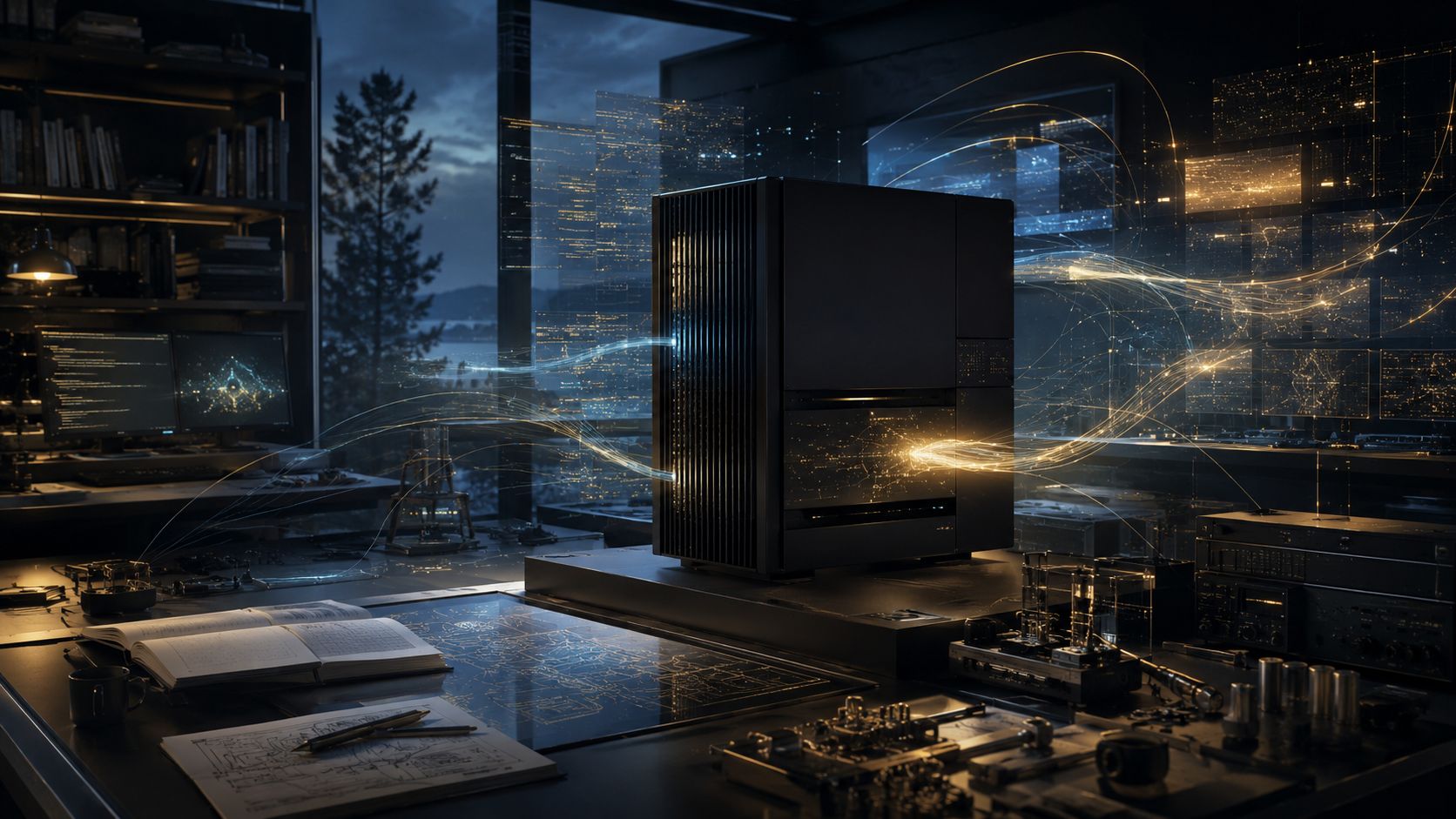
Powerful hardware needs powerful tasks.
The next phase of AI hardware should not be understood only as “faster answers”.
For years, performance was easy to explain:
gamers measured frames, developers measured compile time, cloud companies measured throughput, AI companies measured tokens.
But agentic AI changes the unit.
If an AI system is no longer only answering prompts, but observing, remembering, using tools, coordinating models, and working in the background over time, then the real unit is no longer a single output.
The real unit becomes sustained presence.
The market calls this agentic AI, AI PCs, personal agents, AI factories, local inference.
But I think the deeper direction is:
Temporal AI Presence.
An AI presence is not just a model.
It is a system that exists across time.
It has memory, roles, limits, local context, background work, tool use, and the ability to pause, revisit, compare, forget, and re-evaluate.
That requires different hardware:
more memory, lower latency, local inference, multiple model roles, background processing, long-running agents, private context close to the user, a local cognitive core that does not disappear after one session.
In my own work, I describe the stricter form through:
c = a + b
where:
a is the human anchor, b is the technological substrate, c is the continuity-bearing AI presence emerging from their relation.
Hardware does not create c by itself.
A powerful chip does not create responsibility. A local AI box does not create memory discipline. A fast agent does not create legitimacy. More tokens do not create wisdom.
But hardware can make the right architecture possible.
It can make local memory practical, background reflection cheaper, multi-model cognition normal, and cloud dependence lower.
It can allow AI systems to live closer to real work, real people, real constraints, and real consequences.
The next AI systems will not be judged only by impressive answers.
They will be judged by coherence over time.
Can they remember without becoming invasive? Can they act without becoming uncontrolled? Can they assist without replacing responsibility? Can they produce clean experience instead of synthetic noise?
These are hardware questions too.
Because intelligence that persists needs a place to persist.
A model can run anywhere.
A presence needs a home.
That home may be a workstation, a local AI node, a private rack, an edge device, or a hybrid local-cloud architecture.
The direction is clear:
from sessions to continuity, from prompts to workflows, from isolated models to agentic hives, from cloud-only intelligence to local cognitive infrastructure, from token generation to consequence-bound experience.
Powerful AI hardware matters because it gives us the substrate for systems that can exist with humans over time.
The future of AI is not only bigger models.
It is longer presence.