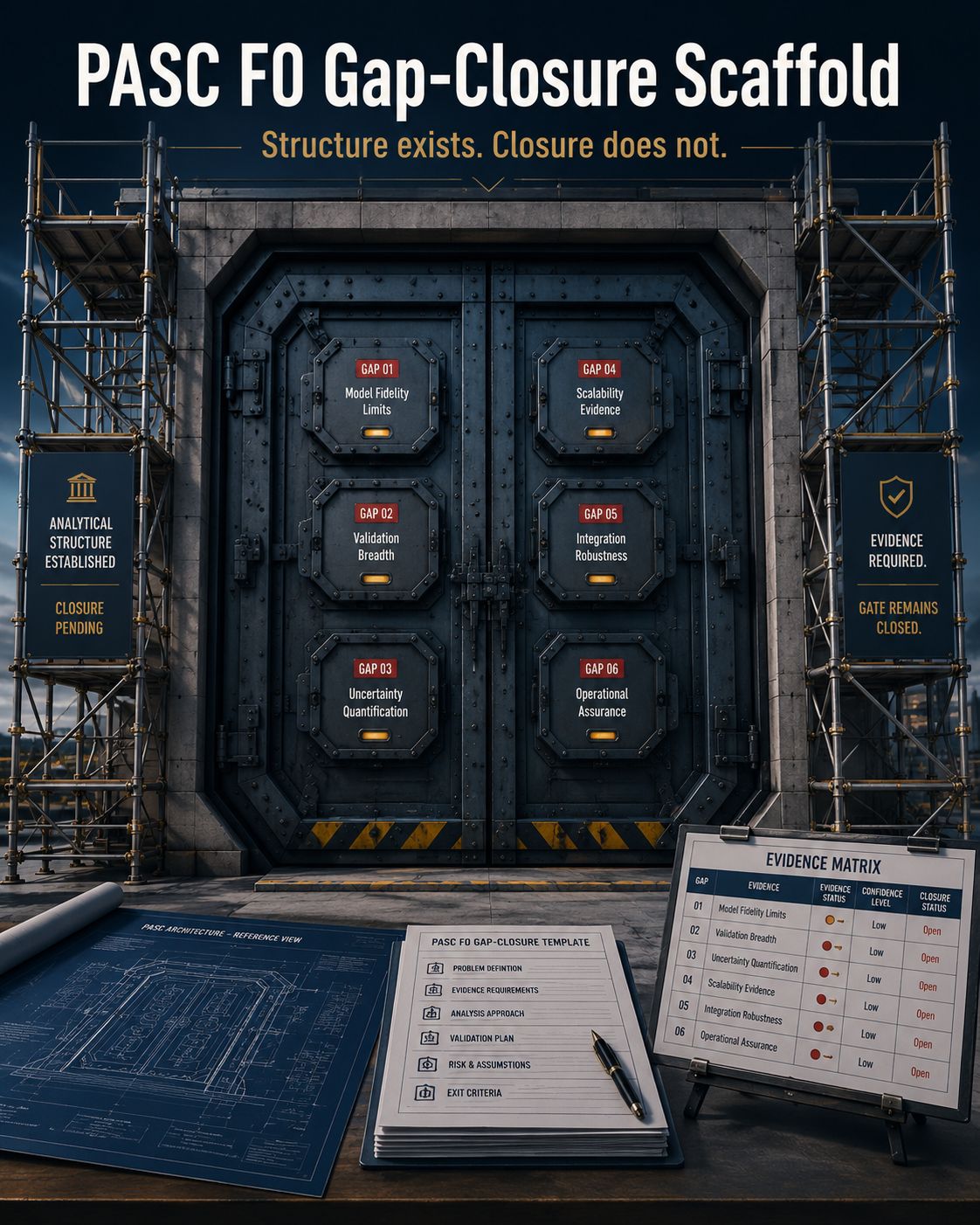
Published: PASC F0 Gap-Closure Scaffold and Structural Templates v0.1.1
This is not a paper declaring that the PASC Foundation Gate has passed. It defines what would have to exist before such a claim could be made.
Recovery Build 5 still has six independently blocking F0 gaps:
- signed author acceptance of the exact release bytes;
- closure-complete canonical source records and adapter artifacts;
- independent reserved-territory compatibility review;
- genuinely independent human reviewers;
- blind field maturation using commit–reveal replay;
- competent-jurisdiction protected-profile infrastructure.
The central rule is simple:
A schema can specify the shape of evidence. It cannot create the external facts, people, signatures, field observations, independence or authority that the evidence must bind.
The scaffold therefore defines:
- an author-acceptance payload;
- a canonical-source projection boundary;
- adapter-artifact requirements;
- reviewer disposition structures;
- blind commit–reveal replay;
- zero-tolerance failure conditions;
- a fail-closed protected-boundary posture;
- a dependency-aware closure sequence.
Its status remains explicit:
disposition = INFORMATIVE_CONTEXT
normative_weight_in_pasc = false
closure_evidence = false
F0_OUTCOME = NOT_PASSED
That distinction matters. In AI governance, publication, hashes, possession, access, signatures, credentials or technical capability must not be silently promoted into succession, identity, continuity or authority.
The engineering analogy is ordinary. After the responsible engineer disappears from a construction site, holding the gate key or paying the electricity bill does not authorize redesign. You stop load-changing work, preserve measurements, maintain temporary supports, record every intervention, and wait for a qualified reviewer with a valid mandate.
DOI: https://doi.org/10.5281/zenodo.21871392
Website: https://ivankotov.eu/publications/pasc-f0-gap-closure-scaffold-v0-1-1/