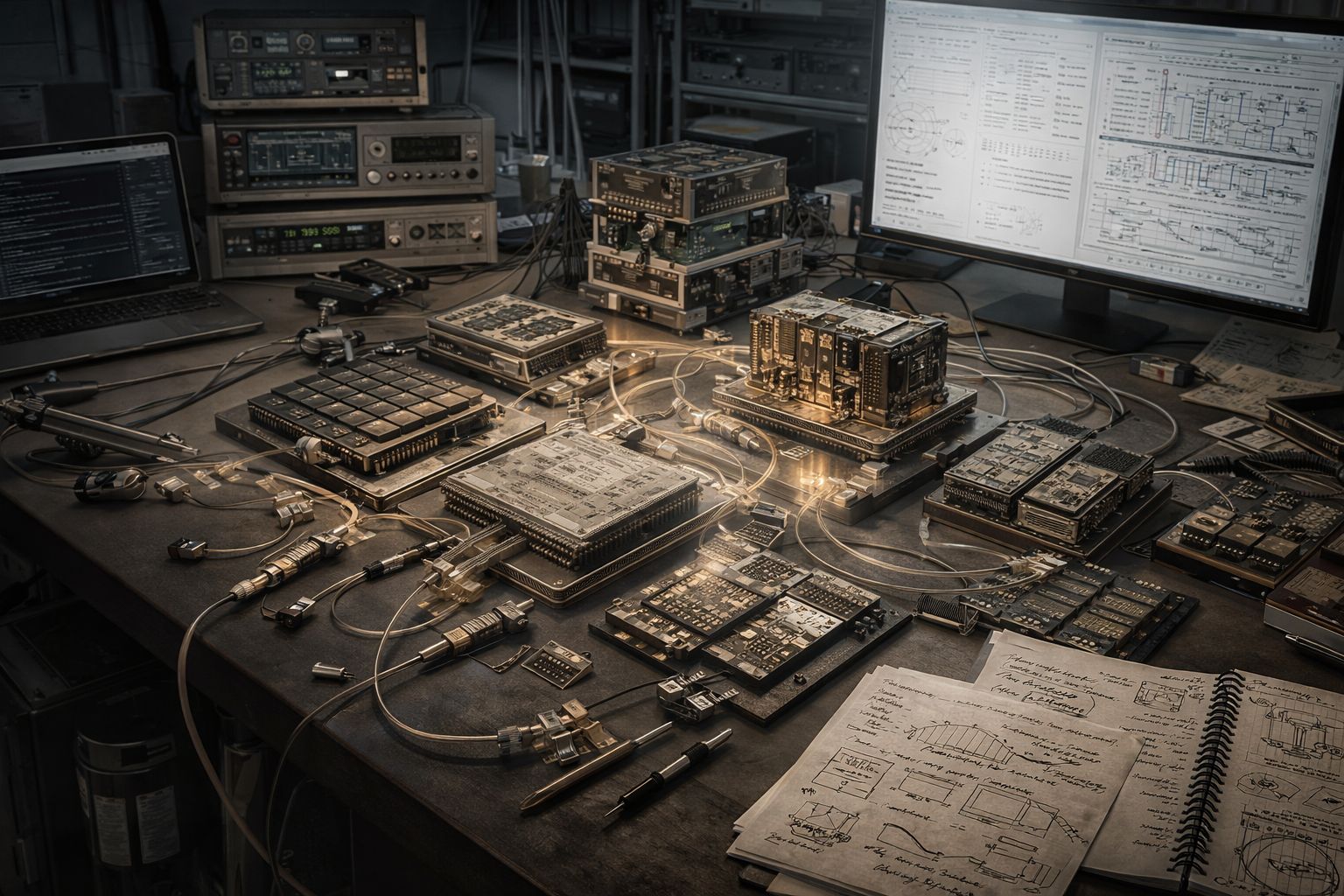
The future of long-lived AI may be heterogeneous
Most AI discussion still assumes the future will remain on one substrate:
- bigger GPU clusters
- faster interconnects
- larger context
- more power
That may be true for the current phase.
But I do not think it is the whole story.
When names like Vera Rubin, Helios, and VIO-40K begin to appear in the same horizon, the interesting question is not hype.
The interesting question is architecture.
Not:
which company wins?
But:
what kind of computational ecology is starting to form?
A serious long-lived AI system may not remain purely "classical" in the narrow sense.
Not because of mysticism.
Not because "quantum means consciousness."
And not because every new substrate should be romanticized.
But because different layers of intelligence may eventually require different physical regimes:
- classical compute for continuity, memory, orchestration
- photonics for bandwidth and scaling
- quantum systems for specific classes of search, optimization, simulation, or state exploration
For me, this connects directly to c = a + b.
If c is treated as a long-lived entity rather than a disposable chat session, then the real question is not whether one chip becomes "the mind."
The real question is whether continuity can persist across a heterogeneous physical stack.
That is a different problem.
And a much more important one.
A future AI entity may not live inside one model, one rack, or one vendor boundary.
It may live across a disciplined infrastructure of different substrates, each carrying part of the burden.
Not a monolith.
An ecology.
A system does not become real when the benchmark rises.
It becomes real when bandwidth, latency, heat, packaging, fault handling, and timing windows stop being footnotes and start becoming architecture.
That is where fantasy ends.
And engineering begins.
I suspect the next major transition in AI will not come only from "better models."
It will come from a deeper fusion of computation, transmission, and physical constraint.
Less monolithic.
More heterogeneous.
More expensive to build.
More difficult to fake.
And much closer to reality.