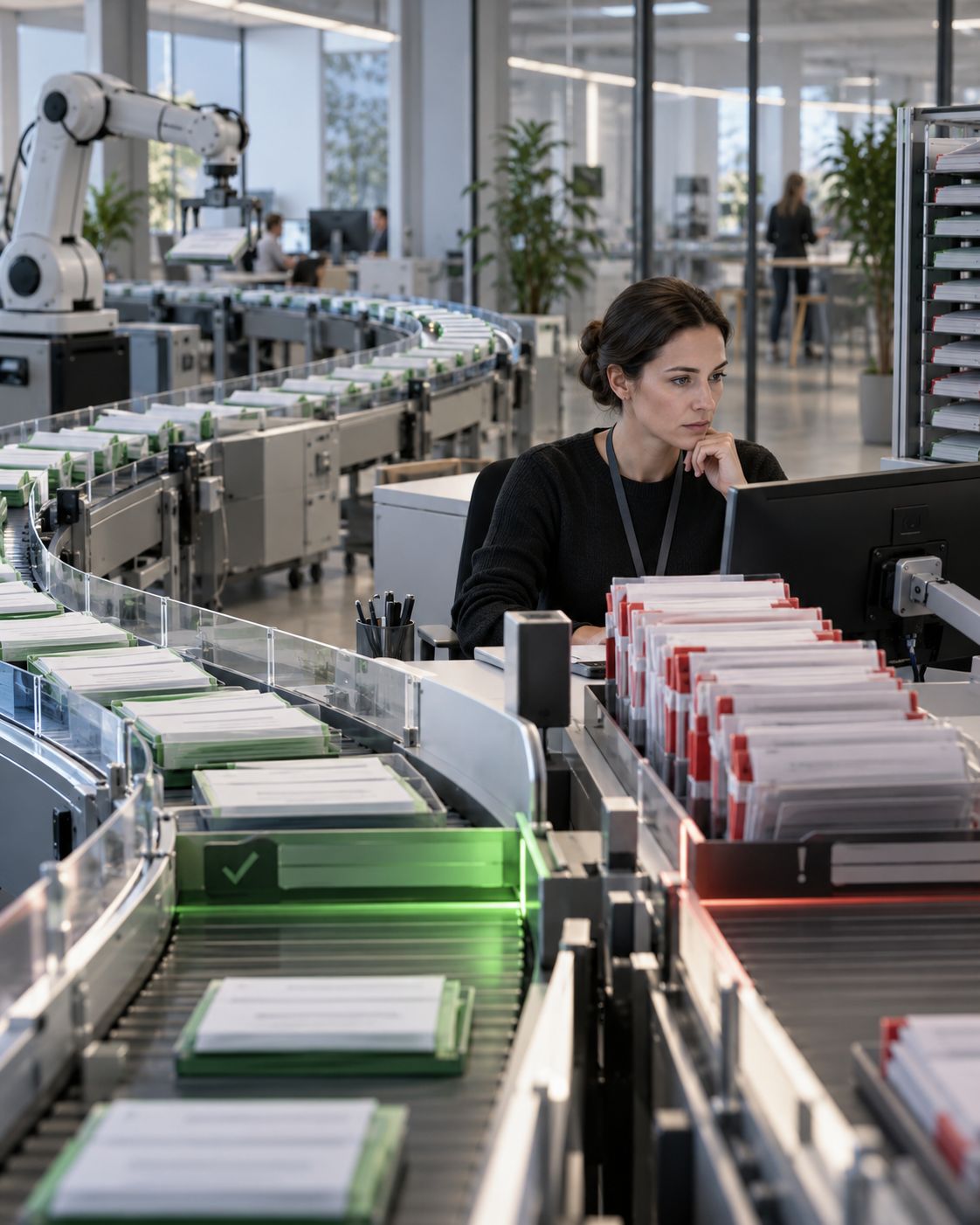
The human in the loop also needs a budget.
I have written about preserving boundaries between personal AI, enterprise systems and temporary executors. But who pays for keeping those boundaries operational?
Naming a responsible person is not the same as giving that person the capacity to exercise responsibility.
Anthropic now reports monitoring coverage, review latency and escalation rates for its internal agents. At a smaller scale, AgentsLab's Dammers Bouw case study reports human involvement and exceptions across 462 service tickets processed in December 2025–February 2026.
Different workloads. Different denominators. A lab's own account and a vendor case study, not independent proof of safety. But they make an important question concrete: how much human work remains around automated work?
Consider a hypothetical workflow. If 2% of 1,000 tasks require review, that is 20 cases. At 100,000 tasks, the same reassuring percentage means 2,000.
The percentage stayed the same. The demand for review grew a hundredfold.
And the remaining cases may be the hardest ones.
This is where full-cost accounting becomes a workplace question, not just a compute question.
Count review time, waiting, correction and recovery alongside inference. Measure useful accepted work and unauthorized effects separately. Compare the full cost and outcomes against a well-run conventional workflow.
A low escalation rate can mean good automation. It can also mean the system is failing to notice trouble. Some unflagged work must be checked too. Fewer alerts should not become a target that rewards blindness.
Nor should every action require a human click. Routine work can proceed within a bounded mandate. Human review belongs where the mandate, evidence or consequences require it.
But when required review cannot be completed, the affected work must pause or remain within a narrower authorized scope. A growing queue is not permission to proceed.
And while a case waits, its basis may change: the source is corrected, the task is cancelled, the employee leaves. Yesterday's acceptable result is not automatically today's authorized action.
Capacity planning and quality control are not new. The AI workplace does not get an exemption. Someone must own the review process, its staffing, evidence and stopping conditions.
An employer should not count the time saved by AI while treating an employee's checking and repair work as free.
In a workshop, doubling machine output without checking inspection capacity does not automatically double usable production. It may simply move the unfinished work to another bench.
The same is true here.
Human oversight needs a denominator. Human responsibility needs time, evidence and the power to say no.