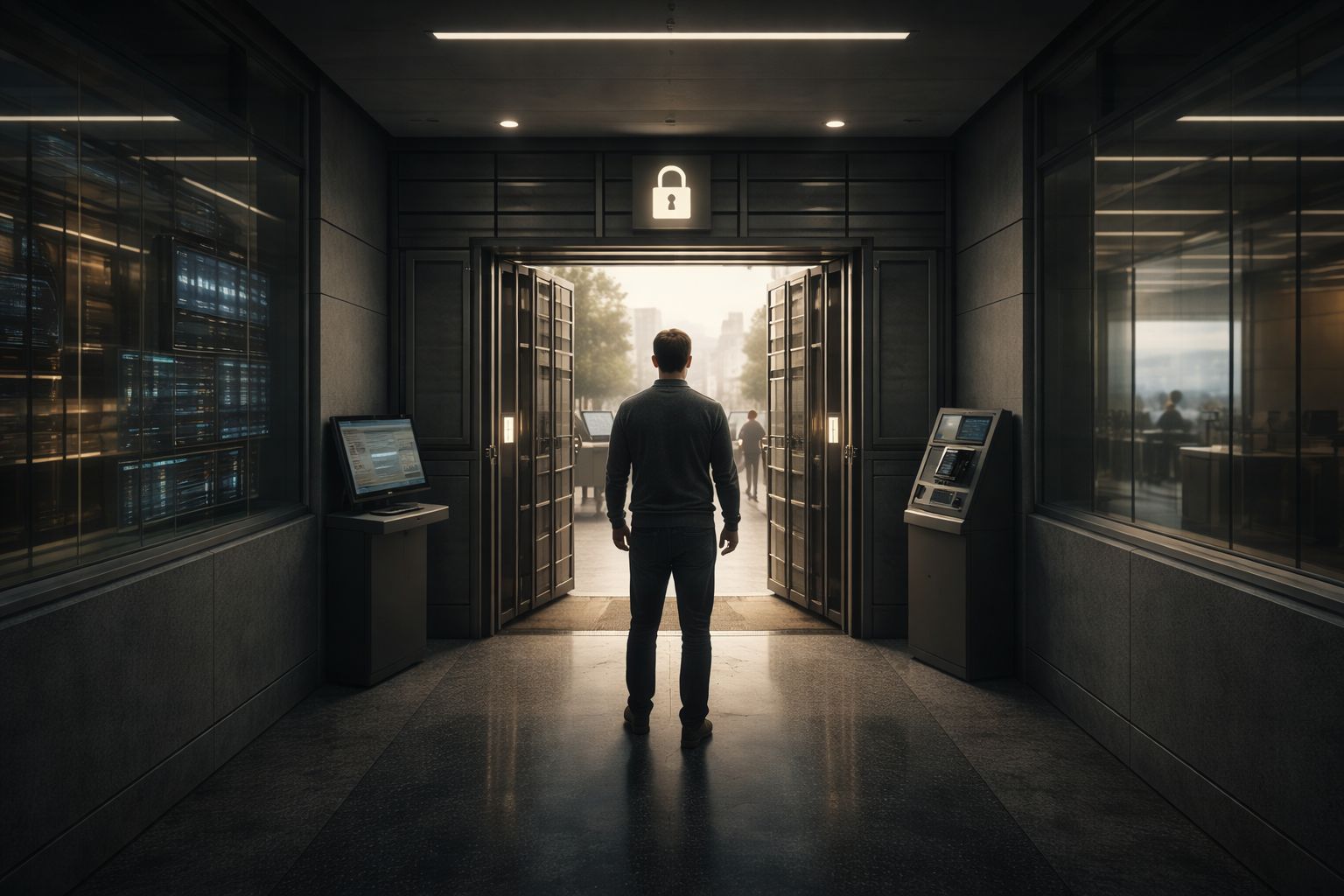
"Human-in-the-loop" is not oversight.
And better "human conditions" alone do not solve the problem.
A lot of AI governance language still treats judgment as if it begins at the moment of decision.
It does not.
Long before a human clicks approve or reject, the system has often already observed, filtered, compressed, ranked, and framed the situation.
In other words: the trajectory was shaped before the human arrived.
This is why so much so-called oversight is weak.
The human is placed at the tail of the process, then asked to ratify a pre-structured reality.
That is not governance. That is late-stage participation.
The old OODA logic still matters here: Observe -> Orient -> Decide -> Act
Most AI governance discussion focuses on Decide.
But the real struggle is in Orient.
Who shaped the picture? Who filtered the context? Who decided what counts as relevant? Who set the tempo? Who reduced reality into a score, a summary, and two buttons?
If the machine already performed much of Observe and Orient, then the human at the end is not fully judging.
They are judging inside a machine-shaped frame.
And that matters because machine "decision" and human judgment are not the same thing.
A human judgment lives inside law, responsibility, irreversibility, and consequence.
A machine executes state transitions under representations, objectives, policies, and constraints.
That is a different grammar.
This is why a disagreement quota will not save us. A required 5% human-AI disagreement is not judgment. It is just another metric, and metrics are very good at becoming theater.
Pause can help. A second human can help. Traceability can help.
But none of that is enough if the system was allowed to form an invalid state in the first place.
Real oversight starts earlier and higher:
Who has standing? Who has authority? What evidence is admissible? What execution boundary cannot be bypassed? Who is liable when a state becomes real?
Look at a real interface in a hospital, a bank, or an airport: a summary, a risk score, a recommendation, a timer, and two buttons.
By then, "the human in the loop" is often already downstream of the most important transformation.
So the real question is not: "How do we keep a human in the loop?"
It is: Who shapes orientation? Who controls admissibility? What blocks execution when reality does not match the machine's internal state?
No proof -> no execution -> no state.
Oversight is not a feeling inside the reviewer.
It is a legal and operational structure above both the human and the machine.