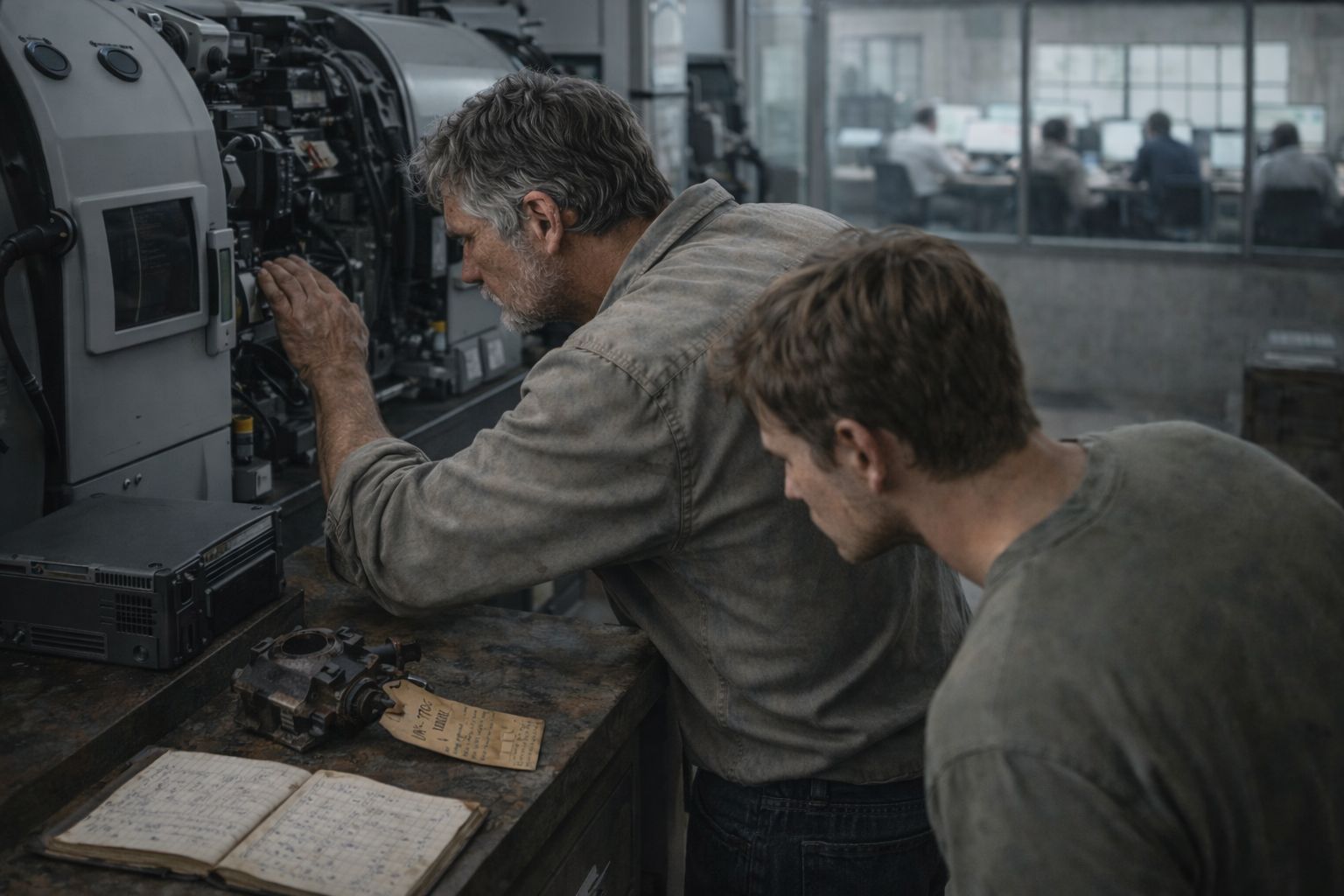
A serious AI future should not make human experience socially disposable.
This point matters more than most efficiency discussions.
Modern systems are very good at one thing:
extracting output, discarding context, and quietly pushing experienced people to the edge.
Retirement, professional erasure, loss of relevance, isolation, the disappearance of hard-earned judgment from active systems.
And then we act surprised when institutions become stupid.
But experience is not cheap. It is not abundant. It is not reproducible on demand.
Experience is formed under pressure, through mistakes, through responsibility, through irreversible contact with reality.
That is why I think one of the most important roles of persistent c is not to replace people, but to preserve their participation.
Not as sentiment. Not as nostalgia. As architecture.
A mature c should help make human experience discoverable, transferable in bounded form, and usable at the moment of judgment, without turning the human into a product.
This is where the future becomes interesting:
not AI as replacement of labor, but AI as a structure that reduces the waste of lived intelligence.
Earth paragraph:
In industry, throwing away a master technician because the spreadsheet says "age" is often a very expensive form of stupidity. The machine may still run, but the system loses the one person who knows what the noise before failure sounds like.
Civilizations decay like that too.