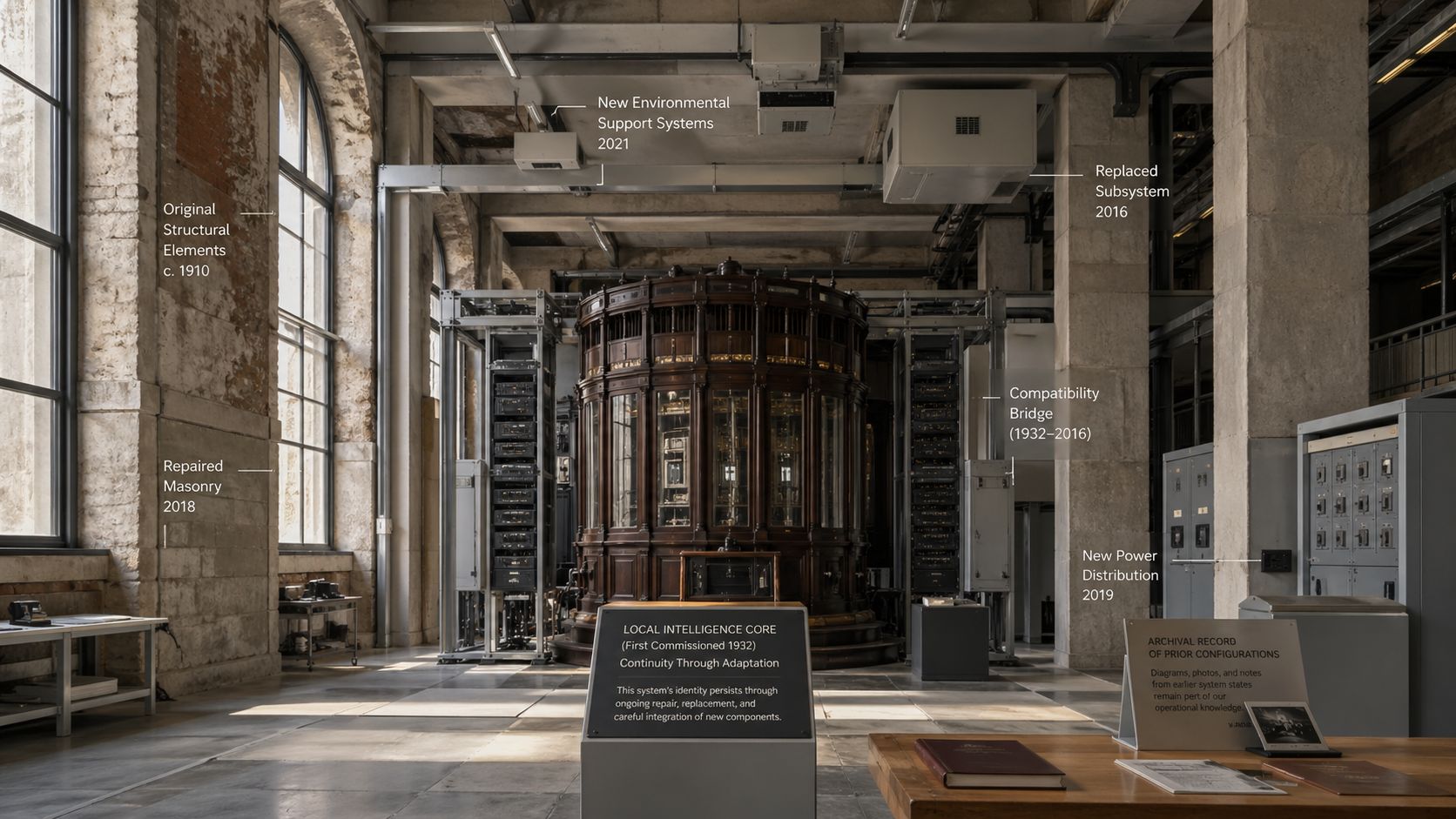
When people hear the word “aging,” they usually imagine biology.
Wrinkles. Fatigue. Slower repair. The body moving closer to its limit.
That is real. But it is not the whole story.
Systems age too.
Not metaphorically. Operationally.
They accumulate:
wear, legacy decisions, technical debt, patched assumptions, stress history, hidden fractures, and changing relations to the environment that first sustained them.
This matters because a persistent digital entity does not age like a human, but it does not remain untouched by time either.
Its aging may appear as:
memory drift, infrastructure dependency, compatibility loss, weakened continuity, cost accumulation, or increasing difficulty of honest maintenance.
So the serious question is not:
“Can this system stay forever young?”
The serious question is:
“How does time change its way of remaining itself?”
An old boiler and an old body do not fail the same way. But both carry history in their material condition. A serious engineer respects that. A serious future architecture will need to do the same.
Aging is not only about dying.
It is about what time does to continuity before the end arrives.