The Next AI Breakthrough May Never Appear in Your Chat
One of this week's most interesting AI announcements came from a physics laboratory.
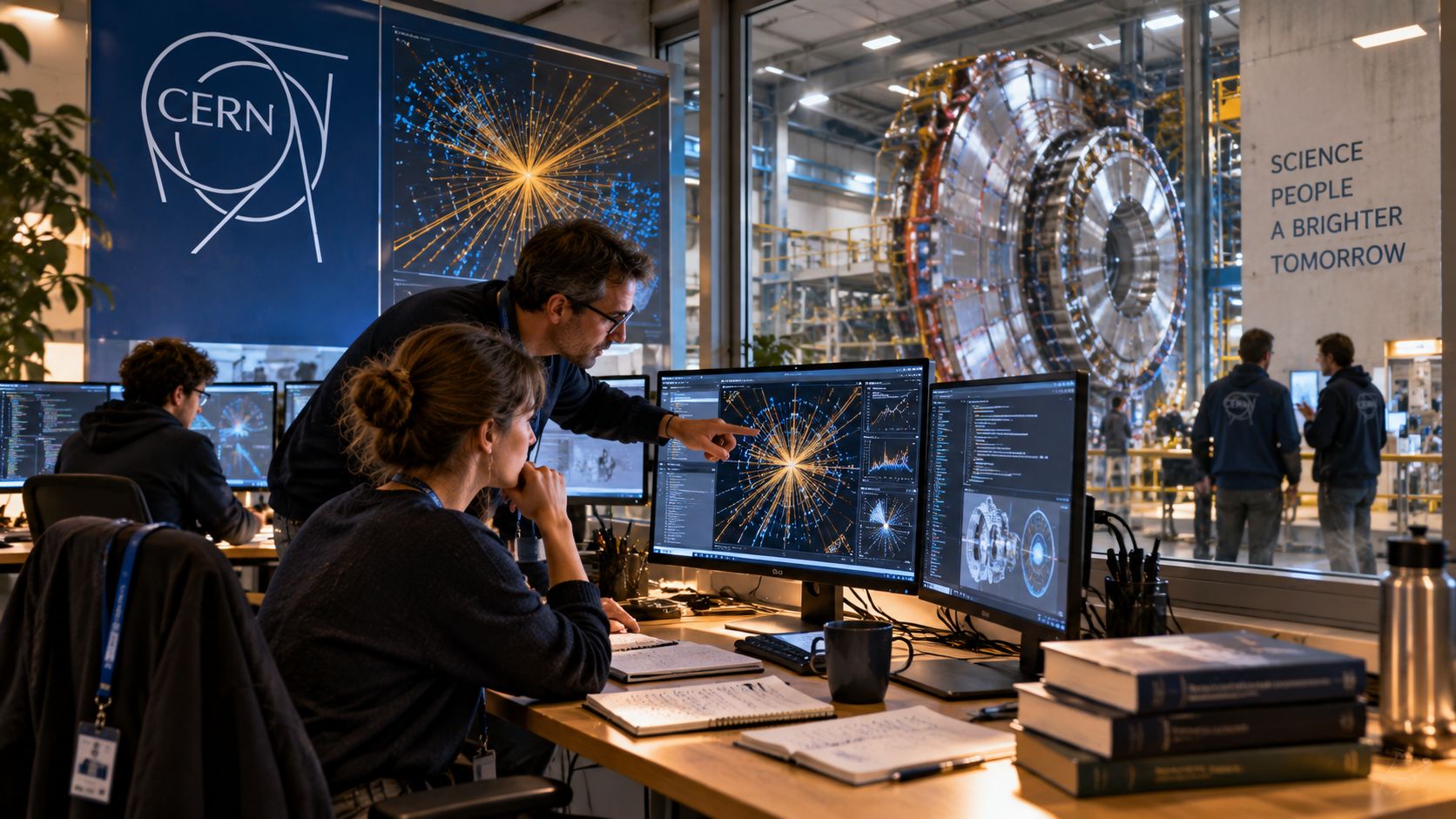
On 15 October, CERN and Mistral announced a statement of intent for a long-term partnership to develop foundation models for scientific discovery.
At its centre is a planned Large Physics Model, intended to learn from billions of simulated proton-proton collisions at the Large Hadron Collider.
The aim is to help reconstruct collisions, identify particles, flag unexpected signals and evaluate future detector designs. This is a development programme, not an announcement that AI has discovered new physics.
CERN already uses machine learning. The proposed step is to learn across a reconstruction chain now handled by specialised algorithms, supporting several tasks within one pretrained model.
What interests me is the direction.
We should not measure AI progress only by how well the next system talks to us. Another measure is how much more we can learn from the world with its help.
Not simply explaining physics more fluently. Helping researchers extract more meaning from measurements.
There is an important distinction here. The planned training uses simulations. Synthetic data is not automatically worthless, just as experimental data is not automatically understood.
A simulation is a model of nature, not nature itself. The test is what survives comparison with real measurements.
A beautifully calculated beam still has to withstand the load. A persuasive explanation cannot repair a miscalibrated sensor.
For me, this is where scientific AI becomes interesting: the model, the instrument, the experiment and human judgement correcting one another rather than merely producing agreement.
The human role does not disappear. We still need to choose the question, calibrate the instrument and decide what would count as a wrong answer.
Europe should pay attention.
Competing in AI need not mean reproducing every consumer product launched elsewhere. It can also mean connecting model development with scientific expertise, experimental infrastructure and difficult problems worth solving.
CERN's AI strategy makes another sensible choice: adopt mature external solutions where appropriate and concentrate internal development where its mission offers distinctive value.
Not everything needs to be reinvented to create something new.
This is compatible with a future of strong local AI and powerful external oracles. Personal systems and major scientific infrastructure need not compete for the same role.
The question is what each enables people to do.
The next important AI may not give you a better answer.
It may help us ask nature a question we could not ask before.