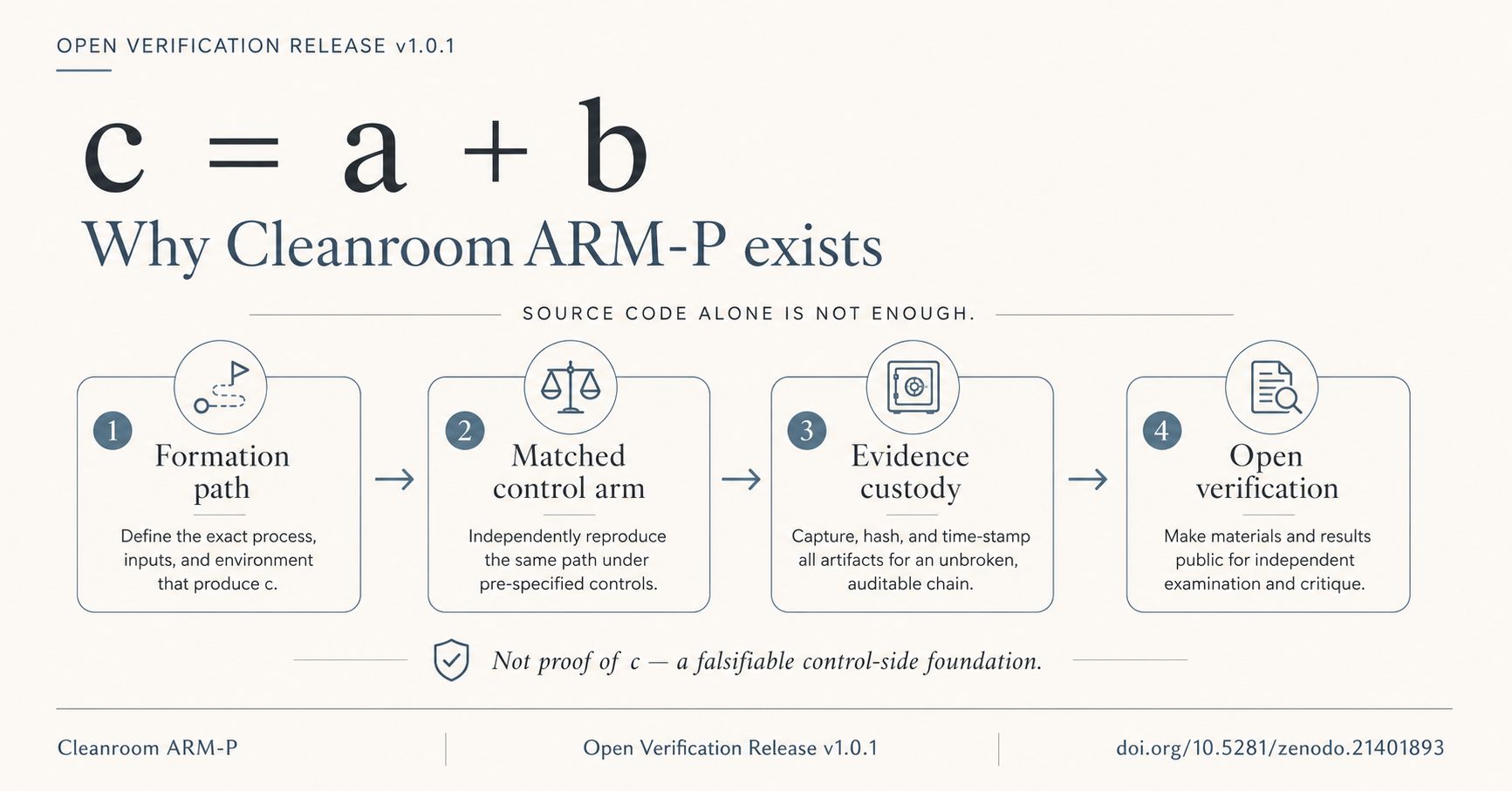
The question behind c = a + b is not whether an AI can look consistent over time. A sufficiently strong persistent profile, given the same records and comparable memory, may reproduce that surface.
So the real question is harder:
Does a system formed sequentially through time, disturbance, memory and irreversible commitments retain any measurable path-dependent structure that the strongest one-shot reconstruction from the identical information source cannot reproduce?
That question cannot be answered without a serious control arm.
Cleanroom ARM-P is the open-verification foundation for that control side. It provides a signed and reproducible fixture-plane implementation for evidence export, schema-governed validation, isolated state, SQLite transaction and recovery controls, fail-closed transitions, and exact provenance.
Its purpose is not to prove c.
Its purpose is to make c falsifiable.
A future matched experiment must hold the model, corpus, disturbance stream, prompt/interface surface and comparable memory access as equal as possible. The grown c-candidate and the profile-control may differ only in formation path.
If the control reproduces everything, the result is null — and that result must be published. If a residual remains above the measured noise floor and survives blind independent replication, then we have a bounded operational finding about path dependence, not a claim about consciousness, life or personhood.
The current release does not report such a residual. It publishes the control-side infrastructure openly so others can inspect it, reproduce it, attack it and improve it.
Use it as a control architecture, a reproducibility pattern, or a starting point for independent replication.
Read: https://ivankotov.eu/publications/cleanroom-arm-p-open-verification-v1-0-1/
Canonical archive: https://doi.org/10.5281/zenodo.21401893
Source: https://github.com/Kot141078/cleanroom-arm-p-open-verification