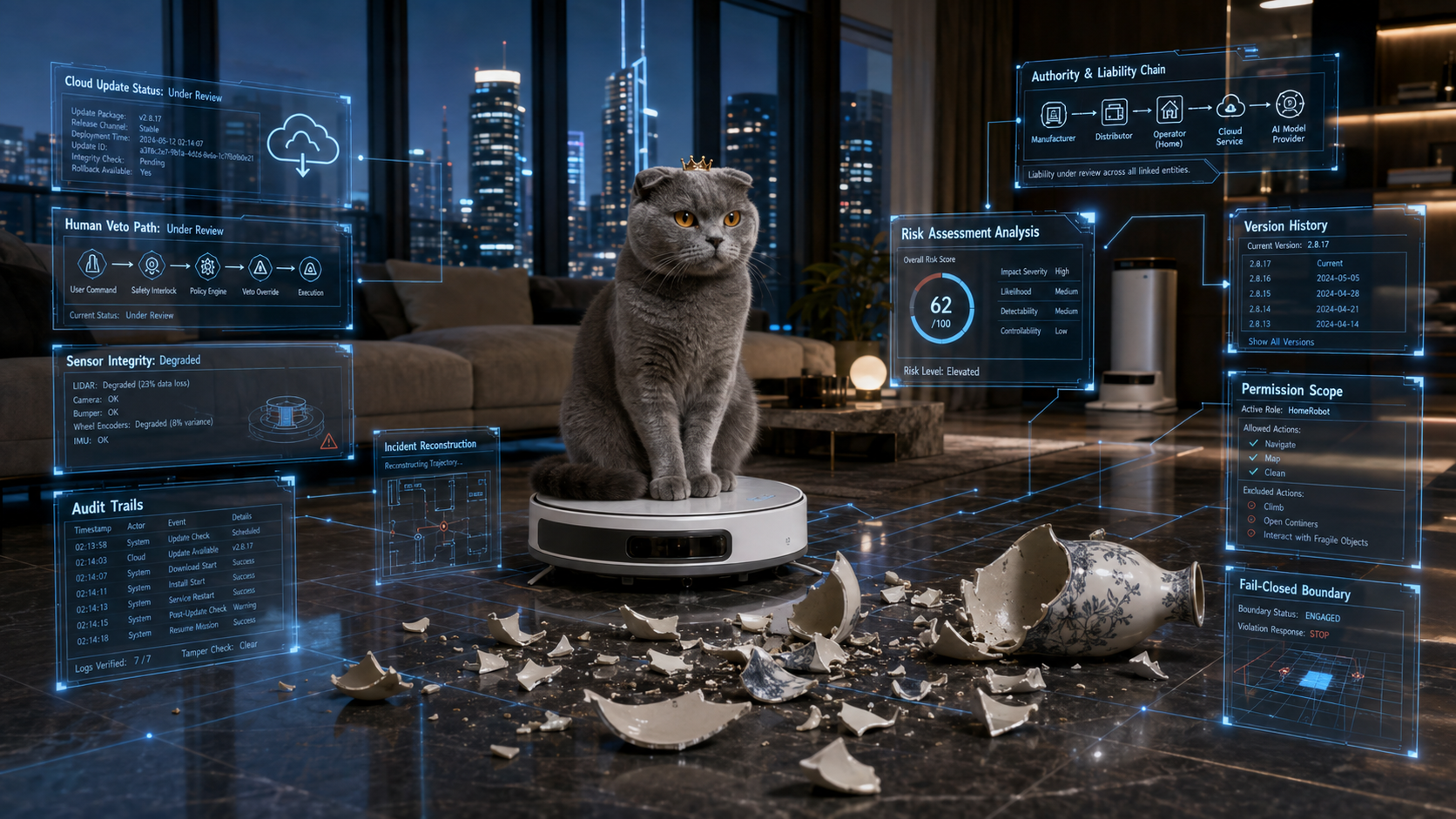
Today I watched my cat proudly riding the robot vacuum. Funny ,- but it led me to a thought.
The missing element in future home robotics may not be intelligence. We will make robots “smart” enough.
It may be insurability.
A home robot damages a wall, injures a visitor, follows an unsafe cloud instruction, changes after an update, or keeps moving after a sensor fails.
The first question will not be:
“How intelligent was the model?”
It will be:
Who had authority to turn a decision into physical action?
Manufacturer? Model provider? Cloud operator? Integrator? Owner? Local agent?
Then comes the second question: who pays?
The causal chain may be scattered across companies, models, logs, devices, and terms of service.
That is not only a legal problem. It is an architectural failure.
Before an insurer can price risk, the event must be reconstructable and the authority chain identifiable.
This is one practical role of c = a + b.
a is the accountable human anchor.
b is the technological substrate: models, agents, hardware, sensors, memory, cloud services, and procedures.
c is the continuity layer governing how intention becomes action across that changing substrate.
This does not make the human liable for everything the robot does. That would be liability laundering.
The purpose of c is the opposite: to stop responsibility dissolving into technical fog.
A serious embodied AI system should show who initiated the action; which model and version participated; whether an external oracle influenced it; which permissions were active; whether a human veto was bypassed; whether sensors or grounding in reality had degraded; which update changed behaviour; and where the system should have failed closed.
A vendor update, an unauthorised cloud instruction, an agent exceeding privilege, and an owner bypassing a safety boundary are different causes.
If evidence is insufficient, the architecture must preserve uncertainty rather than invent confidence to assign blame.
Witness trails, signed update lineage, bounded privileges, local memory custody, challenge windows, freeze paths, and fail-closed behaviour are the technical basis of insurability.
A robot is not a subscription with legs.
It is a moving physical liability surface.
When a load-bearing structure fails, we do not ask the wall to explain itself. We inspect drawings, materials, measurements, site changes, maintenance history, and who authorised the deviation.
A home robot requires the same discipline.
Fluent explanations after an incident are not evidence. A reviewable chain of actions, versions, authority, and consequence is.
c is not an insurer. It is an architectural layer that may make embodied AI risk observable, attributable, governable,- and therefore insurable.
No identifiable authority chain -> no reliable causation -> no scalable insurability.