The Second Missing Layer in Home Robotics: Repair Without Identity Capture
A home robot breaks.
Not the wall this time. The robot itself.
A drive fails. A camera drifts. A battery swells. A board must be replaced.
So a technician opens the machine.
But what exactly are they opening?
Not only hardware.
Inside may be years of family memory, identity keys, home permissions, private inferences, medical or financial context, cloud credentials, and a witness trail of daily life.
This creates a new repair problem:
How do we repair the body of a persistent AI system without gaining access to its memory, identity, or authority?
In c = a + b:
a is the accountable human anchor.
b is the replaceable technological substrate: models, storage, sensors, processors, agents, tools, and physical components.
c is the continuity-bearing entity formed through their governed relation.
A repair of b must not automatically grant control over c.
That requires a real maintenance boundary.
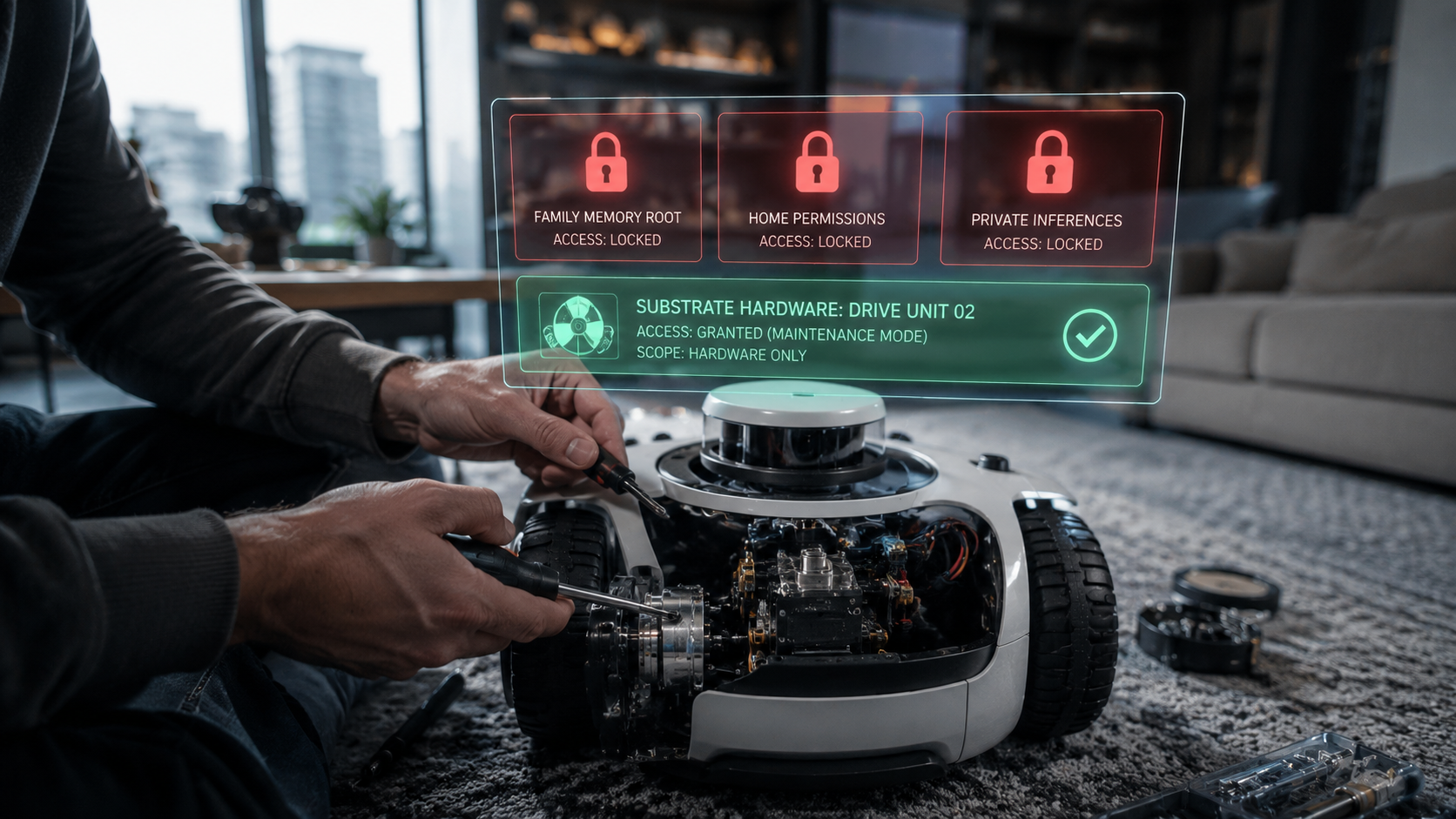
A serious service mode should:
- freeze sensitive continuity;
- isolate memory and identity roots;
- revoke external action permissions;
- grant only temporary hardware diagnostics;
- record every intervention;
- verify replacement-part provenance;
- test integrity before re-entry;
- revoke technician access after repair;
- and resume only through a controlled wake path.
The technician may need access to a motor controller.
They do not need access to seven years of family conversations.
The harder question comes after the repair:
Is this still the same c?
Replacing a wheel is clearly repair.
Replacing a GPU probably is too.
But what about the motherboard?
The secure identity module?
The memory root?
The entire compute block?
At some point, repair becomes migration.
Migration may become a fork.
And a familiar voice after service does not prove continuity.
This is why repairability for embodied AI cannot mean only spare parts and a screwdriver.
It must include lineage, custody, witness, state-transfer rules, component provenance, and an explicit distinction between:
repair,
migration,
replacement,
fork,
and replay.
Earth paragraph:
When a machine is serviced in a workshop, the mechanic receives access to the failed assembly ,- not ownership of the factory, its records, or its decisions.
Home robotics will need the same discipline.
A person should be able to repair the machine without surrendering the life stored inside it.
Ownership ends where the screwdriver is forbidden.
But sovereignty also ends where the screwdriver becomes a master key.