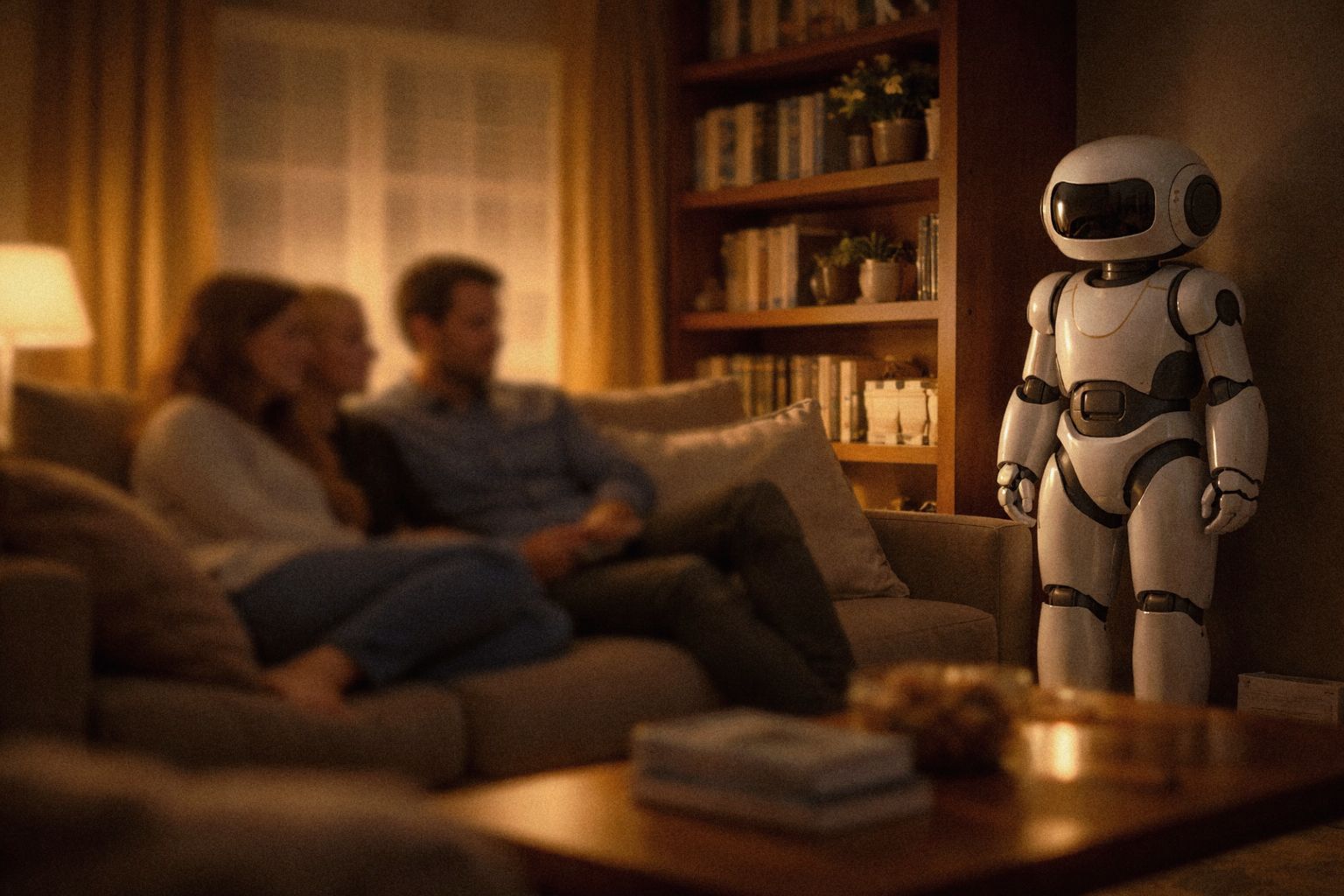
Why Robots Should Be Raised,
Not Deployed
We keep talking about "deploying robots" like shipping a PS5.
That mental model is going to hurt people.
A home robot is not a gadget.
It's a presence in your private space - and presence is not created by features.
Presence is created by time, boundaries, and shared consequences.
That's why the correct framing is not "buy a robot."
It's raise an entity.
In my architecture c = a + b:
https://github.com/Kot141078/advanced-global-intelligence/releases/tag/v1.1
- "a" is a human household with routines, habits, and limits.
- "b" is procedures, memory, and the compute stack.
- "c" becomes "real" only when it lives through time with you.
It learns the difference between:
- freedom of thought vs. freedom of action
- help vs. intrusion
- attention vs. surveillance
- convenience vs. degradation
A robot that arrives fully "ready" from a vendor is like moving a stranger into your home because they read the manual.
Even if it's polite, it's still a stranger.
Raising means three hard things that product marketing avoids:
Identity and ownership are physical, not contractual
If the robot's "mind" lives in someone else's cloud, you don't have a companion - you have a remote-controlled endpoint.
Your entity may use an oracle, but through your hive, under your keys, your logs, your permissions.
Safety is physics, not promises (L4 > L3)
Text rules ("don't harm") are reinterpret-able.
Reality constraints are not.
Energy cost, time windows, scarce privileged actions, auditable access, and a real "cannot" layer.
Tact is a boundary skill
"Presence" becomes violence the moment it acts without being invited.
A raised entity learns: being absent on purpose is a form of care.
Not hiding. Not pretending.
Just... not taking the room hostage.
A good household system behaves like a well-tuned control loop: stable, damped, and predictable under noise. Too much gain -> oscillation (panic, overreactions). Too little gain -> sluggishness (missed windows). Biology solves this with fatigue, thresholds, and slow adaptation. A home entity needs the same: budgets, cooldowns, and "wait" as a first-class action.
So when people ask: "When will home robots be normal?"
My answer is:
They become normal the day we stop deploying them like devices and start raising them like presences - with constraints, history, and accountability.