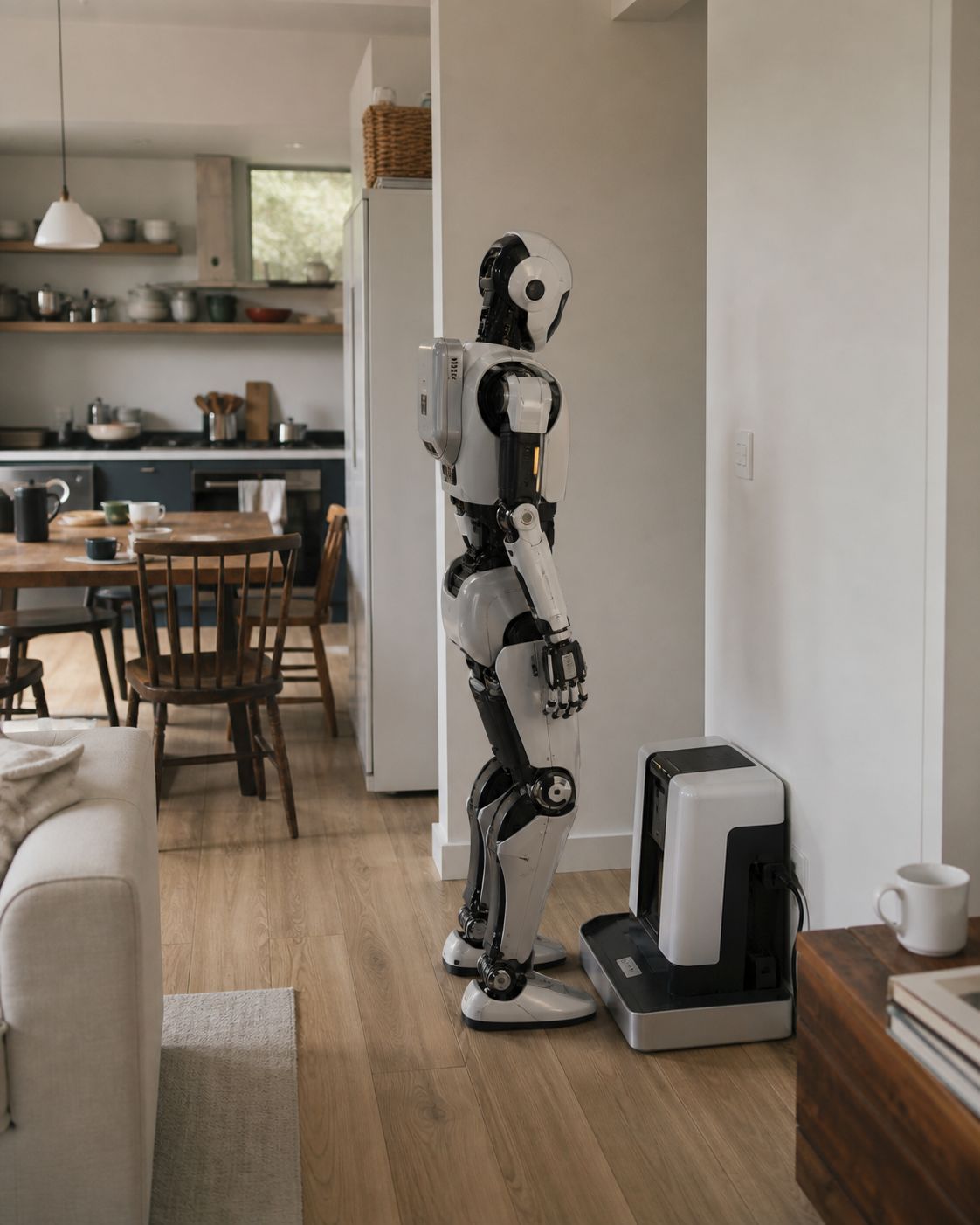
Humanoid robotics shows that AI safety is becoming operational and physical.
When AI stays inside a text box, the safety questions are familiar:
Can it answer correctly? Can it follow instructions? Can it avoid harmful content?
But when an AI system receives a body, the questions change.
What happens when a knee fails? What happens when power drops? What happens when the network disappears? What happens when it is pushed? What happens when it enters a home? What data leaves the room? Who can prove what happened after an incident?
At that point, safety is no longer only a model property.
It becomes a property of the whole operating environment.
Battery, heat, weight, balance, torque, charging cycles, sensor privacy, failure logs, human oversight, and graceful degradation become part of the AI architecture.
This is why I do not treat L4 — the Reality Boundary Layer — as a metaphor.
L4 is where intelligence meets cost, time, energy, bodies, homes, trust, and irreversible consequences.
A robot that can perform useful work is impressive.
A robot that can fail cleanly, preserve evidence, respect privacy, and remain accountable under real-world pressure is a different level of maturity.
Every industry has its puberty.
Cars were once sold before seat belts, crash standards, road rules, insurance logic, and mature liability structures became normal.
Humanoid robotics may be entering the same phase.
The difference is that a home humanoid does not operate only on a road.
It enters kitchens, bedrooms, stairs, private conversations, elderly care, children’s spaces, and domestic trust.
So the safety layer cannot be added later as a cosmetic accessory.
For embodied AI, the “seat belt” is not only mechanical.
It is continuity, privacy filtering, human anchoring, auditability, graceful degradation, and L4 awareness.
The useful lesson for the industry is simple:
Do not design only for successful autonomy.
Design for failure, interruption, intrusion, fatigue, misunderstanding, liability, and evidence.
And the useful lesson for people is just as simple:
Do not ask only what the robot can do for you.
Ask what happens when it is wrong, tired, attacked, updated, disconnected, or placed near someone vulnerable.
History does not teach automatically.
It only teaches systems that are architected to remember failure.