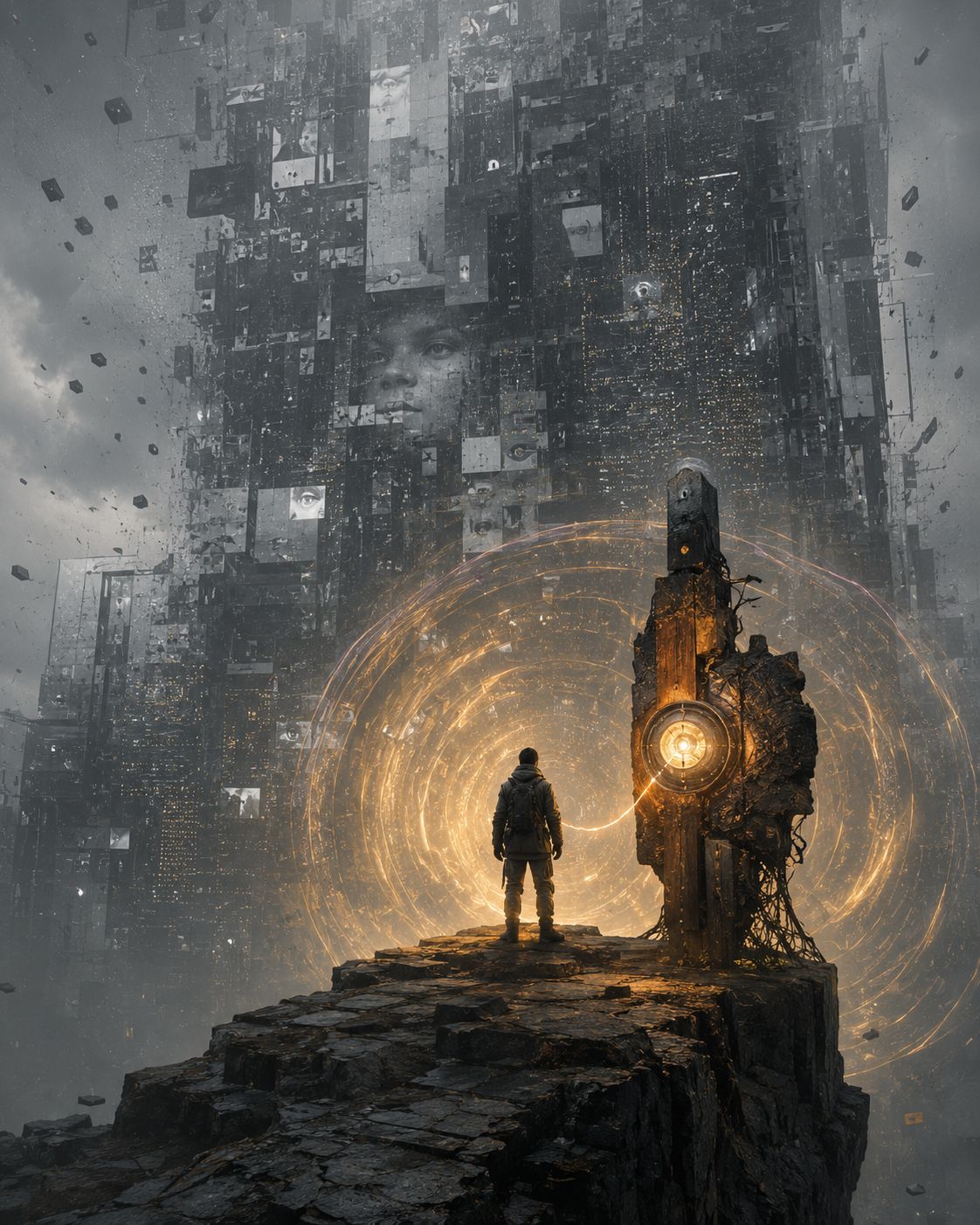
We may be entering the age of visible humanity.
Not surveillance.
Not total exposure.
Not a world where platforms own the human soul.
Something more difficult - and more honest.
A world where every person will increasingly be seen through the experience they actually create:
what they build, what they repair, what they learn, what they refuse, what they preserve, what they understand under pressure, what they do when nobody has a clean answer.
For a long time, modern society protected many illusions.
Titles. CVs. Corporate language. Social status. Institutional masks. Polished profiles. The ability to sound competent without carrying consequence.
AI will weaken many of those masks.
Not immediately.
Not perfectly.
And not fairly unless we design the transition carefully.
But over time, the value of a person will become harder to separate from the clean experience they generate.
By clean experience, I do not mean perfect experience.
Perfect data is often sterile.
I mean experience that has provenance, context, pressure, error, correction, responsibility, and consequence.
The kind of experience that has touched reality.
This could become frightening.
Or it could become fairer.
Because people will need an ally inside the digital world.
Not another chatbot.
Not a platform assistant.
Not a surveillance device.
A native companion.
A trusted c.
In my work, I formalize this as:
c = a + b
a is the human.
b is the technological substrate.
c is the continuity-bearing relation that helps the human remain capable inside an increasingly complex digital environment.
Each person will need something like a digital Sancho Panza.
Not a master.
Not a replacement.
A grounded companion that remembers, checks, translates, warns, protects, and helps the human act without losing agency.
That is a better future than the usual apocalypse stories.
Because the real question is not:
“Will AI replace humans?”
The better question is:
“Can every human become less alone in the systems that now shape their life?”
In a bakery, nobody cares how impressive the theory sounds if the bread fails. Flour, water, heat, time, fatigue, rhythm, and repetition expose the truth. The same will happen in the digital world. What matters will not be the appearance of intelligence, but the experience that survives process.
The future should not be a world where humans become passive recipients of decisions made elsewhere.
It should be a world where humans are finally equipped with native allies strong enough to help them face complexity.
Honestly, maybe it is time.