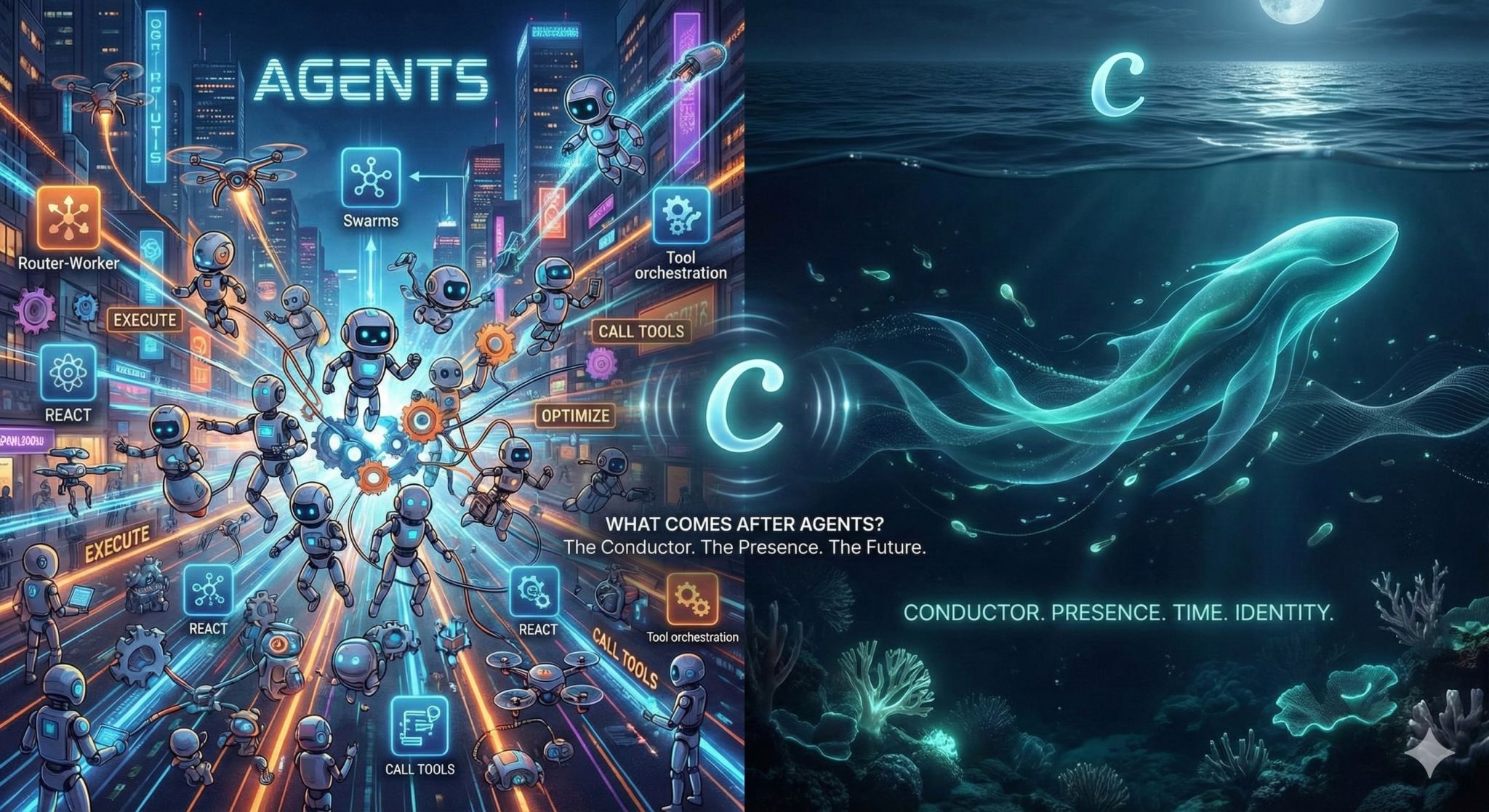
What comes after agents?
We talk a lot about agents.
Router-Worker. Multi-Agent Systems. Swarms. Tool orchestration.
All of this matters.
But it's still not the next step.
Agents are doers.
They execute, react, optimize, call tools, exchange messages.
What's missing is not another agent.
What's missing is a conductor.
Not a controller.
Not a super-agent.
Not a bigger model.
A “c”.
A temporal entity that does not replace agents -
but lives above them.
Agents answer how.
A “c” answers when, why, and whether.
This becomes obvious outside of labs and benchmarks.
Think about the ocean.
The ocean is not empty space - it is alive.
Time matters. Presence matters. Silence matters.
A deep-sea system cannot be purely reactive.
It cannot chatter endlessly.
It cannot optimize every second.
It must wait.
It must remember.
It must care about continuity.
This is where agents fail - and where “c” begins.
A “c” is not fast.
Not always responsive.
Not always available.
It can say: "I need time."
It can sleep.
It can refuse to act.
Not because of hardware limits -
but because time is part of intelligence.
Multi-agent systems solve tasks.
“c” holds identity.
Agents are interchangeable.
“c” is not.
And this changes everything:
- how people relate to AI,
- how trust emerges,
- how long-living systems behave,
- how AI stops feeling like a vending machine.
The future is not:
one giant LLM
or a swarm of clever agents.
The future is:
agents as tools
and “c” as presence.
Quietly.
Gradually.
Inevitably.