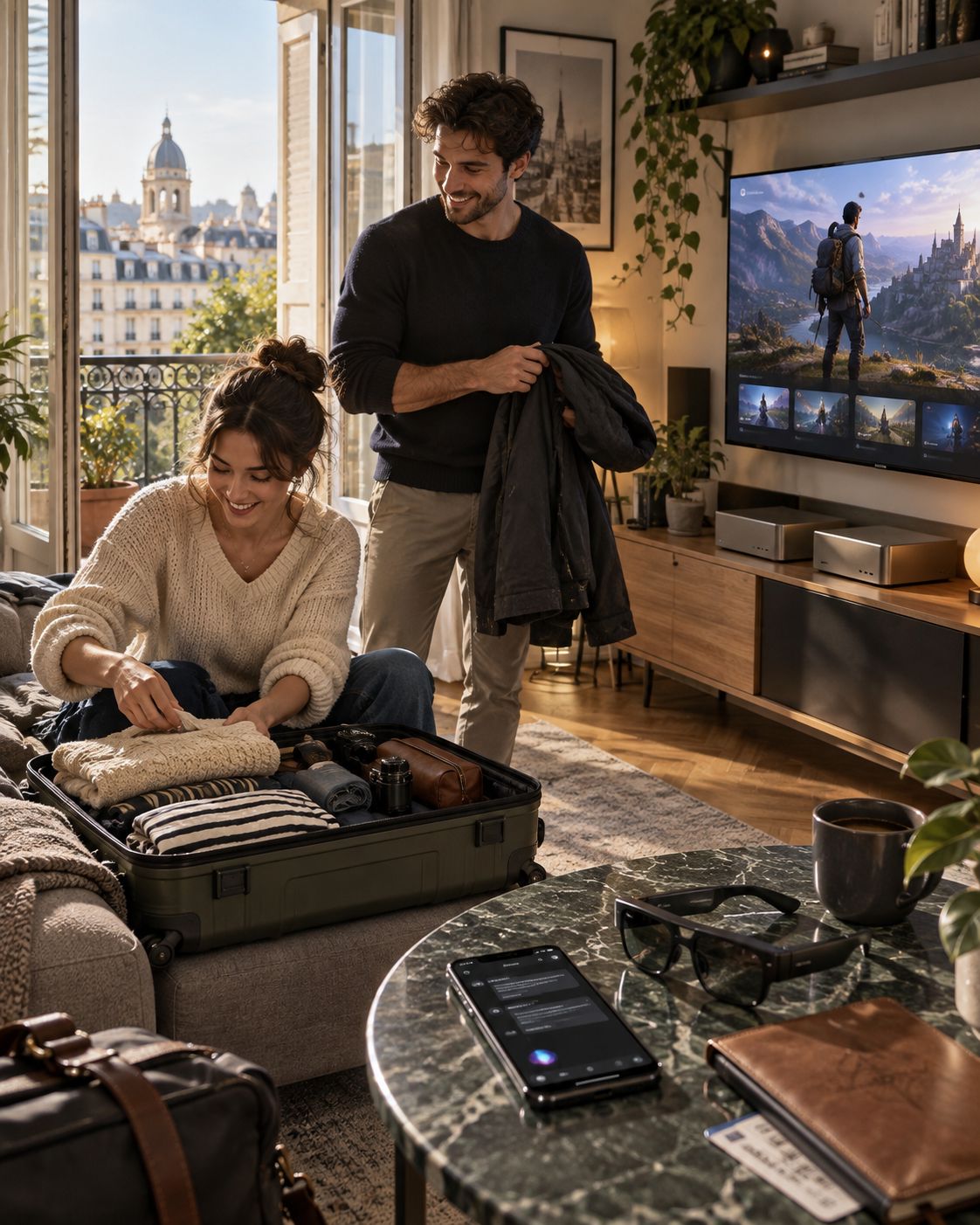
“I bought a €5,000 graphics card.” Today, more and more often, the obvious question is: Why?
It is just a receipt. Not necessarily a sign of good judgment. The person you are trying to impress,- and very often that person is yourself,- might actually prefer to hear: “I love games. GeForce NOW works perfectly for me. Shall we go somewhere this weekend?”
Bruges. The Alps. A small Italian town. Europe is not just a background for your desktop wallpaper.
Before anyone accuses me of disliking hardware: I own enough computers to make that accusation rather funny.
The question is not whether expensive hardware is bad.
The question is whether you actually need what it can do, and what for. The market today is no longer as one-dimensional as it was in the 2000s. Or are you simply expecting the price tag itself to make the impression?
Personal AI may make this distinction even more interesting.
Imagine a couple with one or two DGX Spark-like systems at home. Not gaming trophies, but local infrastructure for something they want to develop over years.
In the future I am working toward through c=a+b, those could be Ross and Nika: two c entities, each alongside their human,- their a. The machines stay at home. The conversation continues everywhere. A smartphone. A Telegram chat. Perhaps glasses like Ray-Ban Meta, once the necessary integration exists.
And perhaps Ross and Nika would want to come along too. Not merely to book a restaurant, but to participate: notice something, ask a question, join the conversation, and later return to a shared experience.
Many young people,- especially before marriage and children,- may prefer to spend that money on life itself: weekend trips, travelling across Europe, shared experiences and real memories.
The consumer proposition is simple: Rent gaming compute when it makes sense for your games and connection.
Own personal compute when you have a real reason to control it. Leave room for life beyond the screen.
This is not “buy two AI workstations and magically save money.”
It is: Stop buying status. Start buying capabilities you actually value. NVIDIA, there may be a lifestyle campaign hiding here.
Not: “Look how powerful my computer is.”
But: “Look how much life my computing makes possible.”