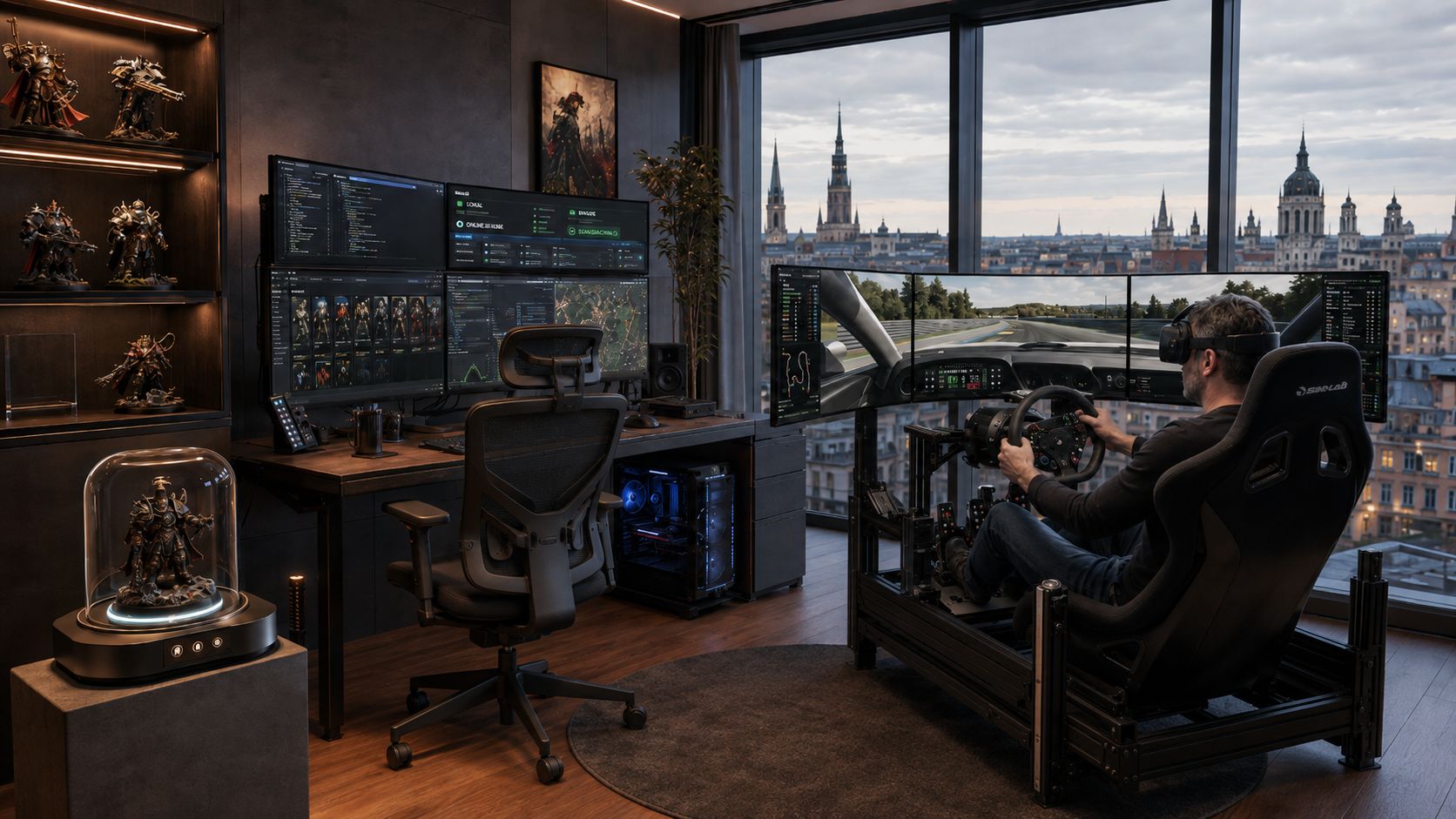
Every now and then, between my usual thoughts on AI, infrastructure and machine intelligence, the old PC geek in me stages a small rebellion. Today is one of those days.
My complaint about modern AAA games is not that “AI is ruining art.”
It is that we keep building astonishing virtual worlds while narrowing the ways users are allowed to inhabit them.
A game may contain cars, aircraft and helicopters, yet offer weak native support for a proper wheel, HOTAS, yoke or VR display mode.
At the scale of modern blockbuster development, prettier worlds should come with richer ways to inhabit them.
For many adult players, these are not exotic toys. We have been gaming for decades. We already own cockpits, direct-drive wheels, load-cell pedals, HOTAS systems, ultrawides, VR headsets and powerful PCs.
VR does not have to mean waving two controllers around.
Let the wheel drive the car.
Let HOTAS fly the aircraft.
Let mouse and keyboard control the character on foot.
Let VR simply be a stereoscopic display with scale and head tracking.
That should not be radical in 2026.
And yes, I think much more gaming should move to the cloud. I use GeForce NOW happily. My complaint is almost embarrassingly capitalist:
Give me MORE compute and send me the bill.
Offer enthusiast tiers: more GPU power, more bitrate, better peripheral passthrough, VR support, perhaps even dedicated compute instances.
The future may move computation to the cloud. It should not move user agency there with it.
The same applies to ownership. I am not nostalgic about optical discs that increasingly cannot hold the full product anyway.
A practical transition model is possible: sell a signed, encrypted archival build that lives on a removable NVMe. Let the customer provide the drive—or sell a beautiful collector’s object whose base contains it. Put it on the shelf. Allow secure ownership transfer for resale.
Physical ownership survives. Distribution becomes digital. Everyone moves forward.
AI already shows part of the answer. Consumer products can remain simple while APIs, higher tiers and local models give advanced users room to go further.
Gaming needs the same principle:
Make the default easy, but do not turn the default into a ceiling.
I am not asking every player to own a cockpit, use VR or buy premium cloud compute. I am asking the industry not to close the door on those who do.
My objection is not to cloud gaming, AI, DLSS or digital distribution.
It is to a future where technology becomes more powerful while the user is offered a smaller, more prescribed experience.
Convenience should not require surrendering capability.