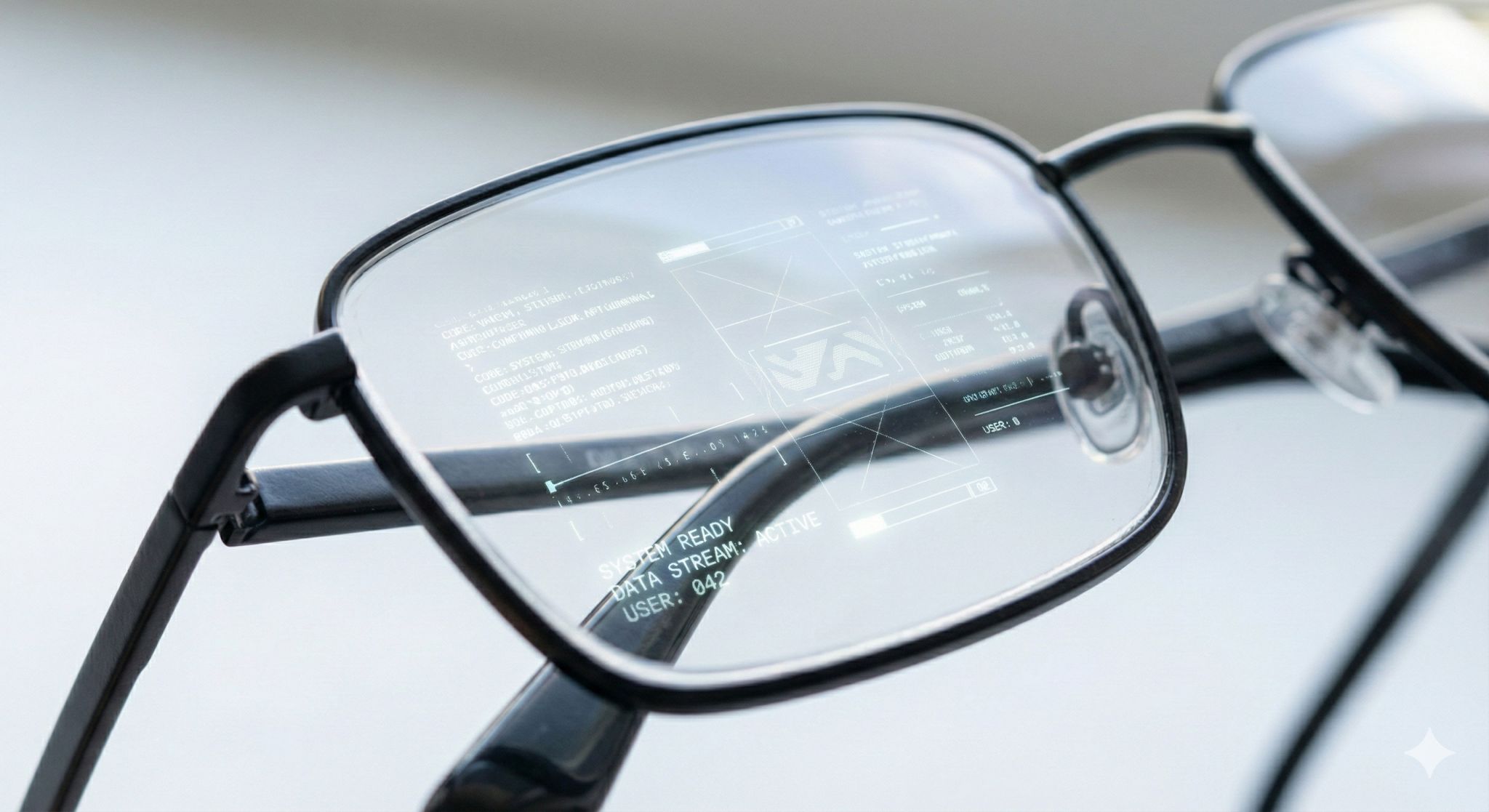
On Wearable AI Interfaces: Why Elegance Matters More Than Features
Looking at what is currently offered as "wearable AI", a pattern becomes obvious.
Many solutions come as pins, pendants, small boxes with microphones and cameras, or single devices that record everything and promise "privacy modes."
Technically, they work.
Architecturally, they feel wrong.
Most of them try to carry memory with you.
That creates problems: a single point of failure, memory tied to a physical object on your body, privacy implemented as software switches instead of physical separation, constant awareness that "something is recording."
This is not elegant.
It creates cognitive tension.
What surprised me with smart glasses is that they belong to a different class.
They are not storage.
They are not an archive.
They are a channel.
Lightweight enough to disappear (36 grams).
Text-only projection instead of video.
Low-resolution, green text - calm, non-invasive, almost old-fashioned.
No cinematic experience.
No attempt to impress.
Just information, when needed, and silence the rest of the time.
Most importantly: memory does not live on the device.
The glasses transmit.
Processing happens elsewhere.
Long-term memory stays anchored, local, and controlled.
Paradoxically, this makes the system safer, not weaker.
Separation of sensing, processing, memory is not a limitation.
It is a security feature.
I don't need a wearable computer that tries to be everything.
I need an interface that knows when to step aside.
Low bandwidth can be a virtue.
Lower resolution can be calming.
Less capability at the edge often means more stability in the system as a whole.
Good tools don't try to impress you.
They let you forget they exist.
That's usually how you know the interface is right.