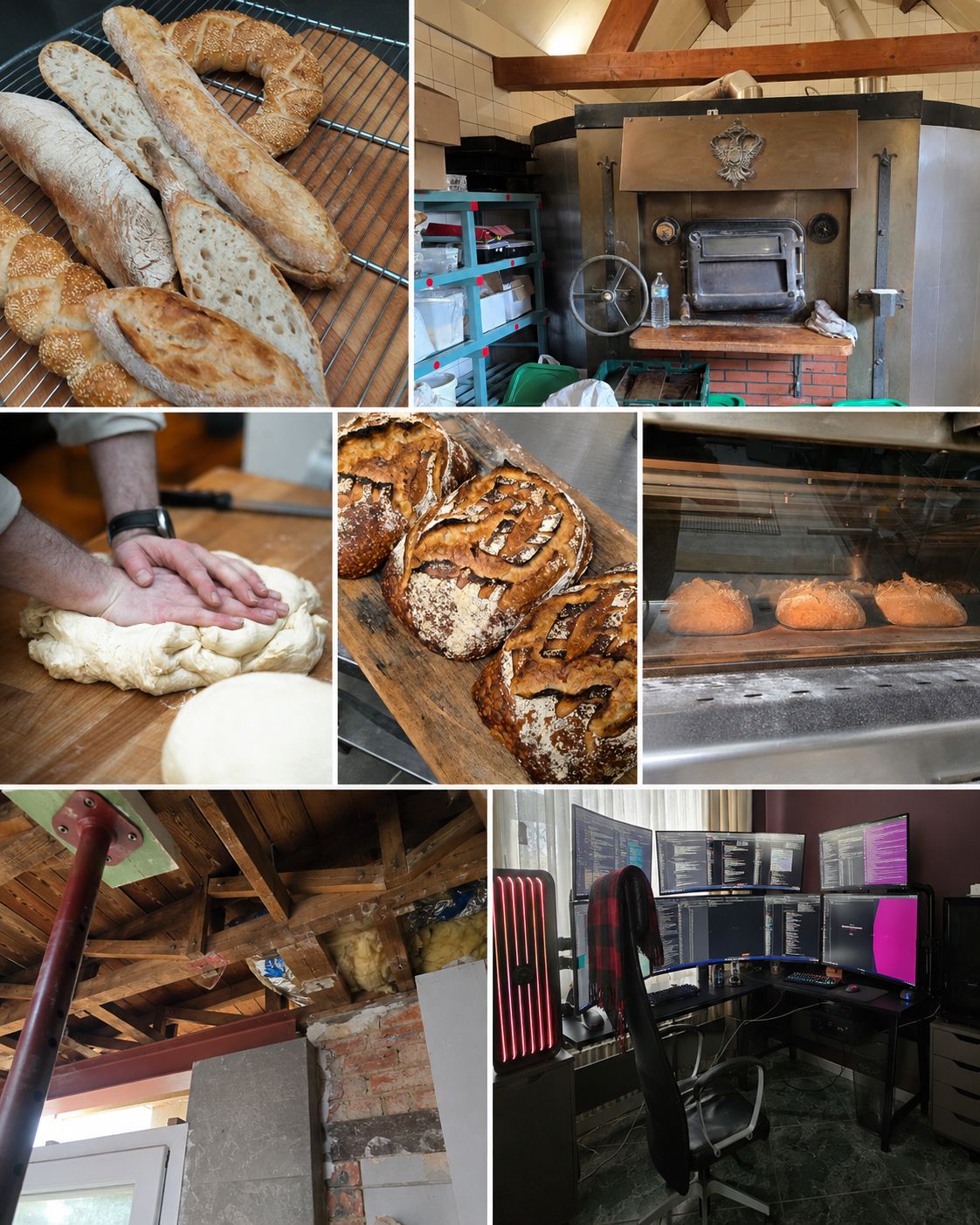
Saturday thought.
For some people, rest is not always the absence of work.
Sometimes it is a change of medium.
After too many hours inside code, documents, systems, screens, and abstraction, the mind does not always recover by doing nothing. Sometimes it recovers by returning to materials, tools, heat, weight, rhythm, and physical sequence.
I have learned this the practical way over many years: if all effort is concentrated into one channel, even meaningful work can become mentally corrosive. Changing the kind of work is often more restorative than stopping entirely.
Bread does that. Construction does that. Any real craft can do that.
Different kinds of work test different parts of a person.
Software tests attention, abstraction, logic, patience, and tolerance for invisible errors.
Construction tests sequence, geometry, force, responsibility, and respect for materials.
Bread tests time, temperature, touch, humidity, and restraint.
The material world is very honest.
The dough rises or it does not. The floor is level or it is not. The wall is straight or it is not. The pipe leaks or it does not.
No slogans. No vibes. No decorative intelligence.
Just feedback.
In the age of AI, this matters even more.
Modern tools can multiply output, drafts, code, analysis, and possible futures. That is useful. But it can also overload the same mental channel for too long.
A person needs more than productivity. A person needs more than one feedback loop.
Sometimes the best protection against burnout is not less activity, but different activity.
This does not mean replacing exhaustion with another obligation. Sometimes the body needs sleep and complete rest. But sometimes the mind needs a different kind of work.
Not escape. Not nostalgia. Not rejection of technology.
Just a change of reality channel.
Keep one part of your life connected to material truth. Something that answers with resistance. Something that cannot be persuaded by language. Something that keeps the mind honest.
For some people, that is not a hobby. It is maintenance.
And perhaps a modest protection against the “uprising of the machines”:
not by rejecting machines, but by remaining capable with and without them.