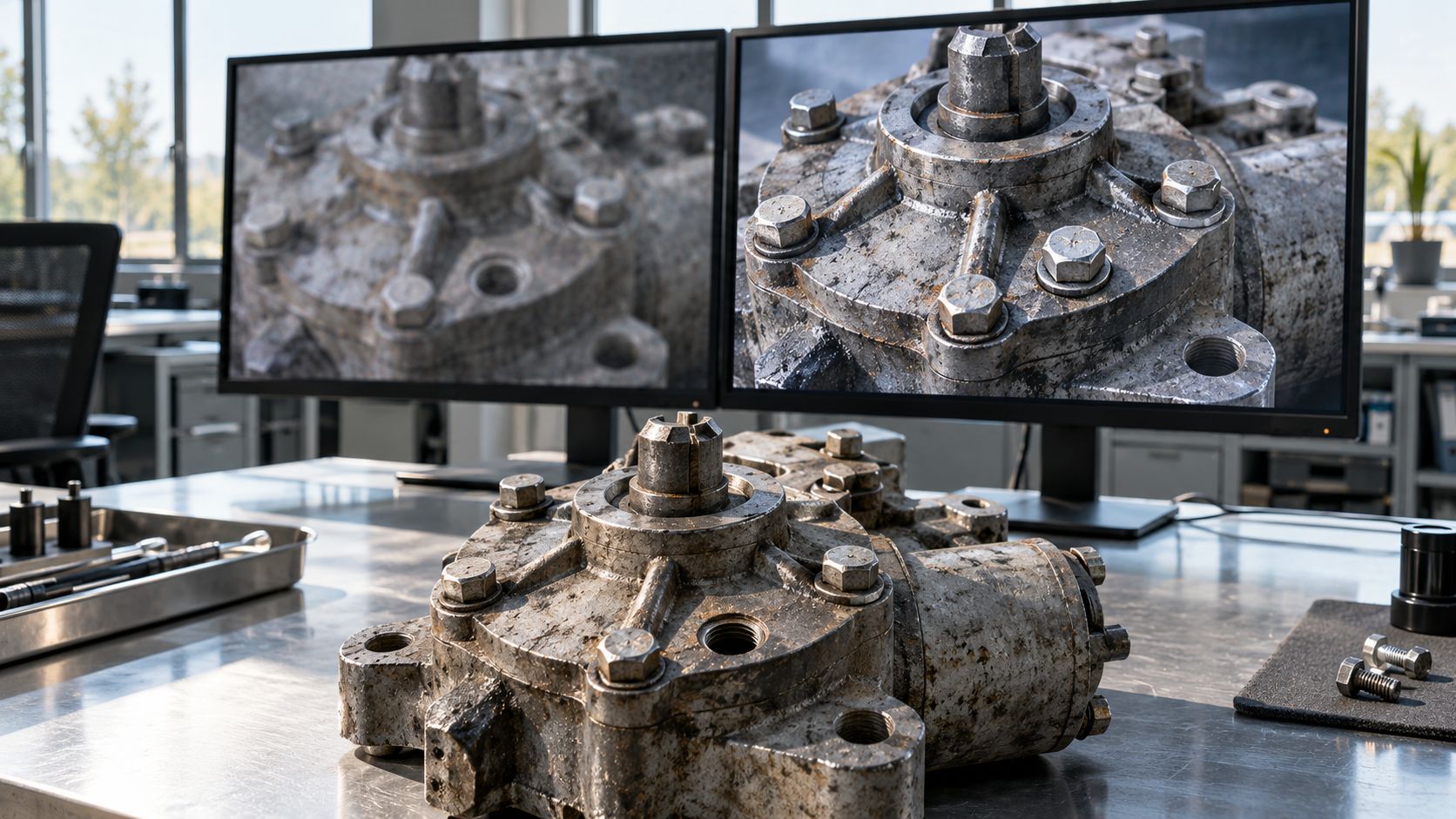
The Photo Got Sharper. The Evidence Got Worse.
Imagine a blurry photograph attached to a technical report. One small detail matters: is that a crack, a reflection, or simply an image artifact?
Someone clicks “enhance”.
Suddenly, the surface is crisp. The edges look clean. The uncertainty seems to disappear.
But did the camera actually capture those details, or did the software reconstruct something plausible?
“Then just take photographs without enhancement,” someone might say.
A reasonable suggestion. But the problem is more complicated.
Modern smartphones routinely apply noise reduction, sharpening, HDR, and other computational corrections before a photograph is even saved.
Messaging platforms may resize or compress it. AI systems may subsequently interpret what they see.
These are different operations, with different risks. Not every image-processing technique invents information.
But a processed image is not necessarily an untouched observation.
A recent study from Seoul National University, published on 19 October, examines this problem through VHA, a method for assessing hallucinations in generative image super-resolution.
The researchers show that visually convincing reconstructions can introduce unsupported details or alter existing ones. Conventional image-quality metrics may even favour less faithful results.
Crucially, their evaluation compares reconstructed images against high-resolution ground truth.
And that is exactly what we often lack in real situations.
If the original photograph contains insufficient information, making it sharper does not magically recover the missing evidence.
Now consider what happens next.
The processed photograph enters a report. Another AI summarises that report. A person or another system relies on the summary.
Somewhere along the way, a plausible reconstruction can lose its uncertainty label and become an apparently established fact.
Nobody needs to lie. Nobody needs malicious intentions.
A poorly documented chain of perfectly ordinary operations is enough.
The solution is not to abandon image processing or AI.
It is to preserve the earliest available source, document significant transformations, distinguish reconstruction from observation, and independently verify details that matter.
The same principle applies far beyond photographs: documents, measurements, scientific results, and AI-generated summaries.
Every transformation can be useful.
But usefulness does not automatically confer evidential authority.
A photograph can be unclear. A reconstruction can be beautifully wrong. And uncertainty does not disappear merely because the pixels look better.
Research: https://lnkd.in/ePcCCQZe