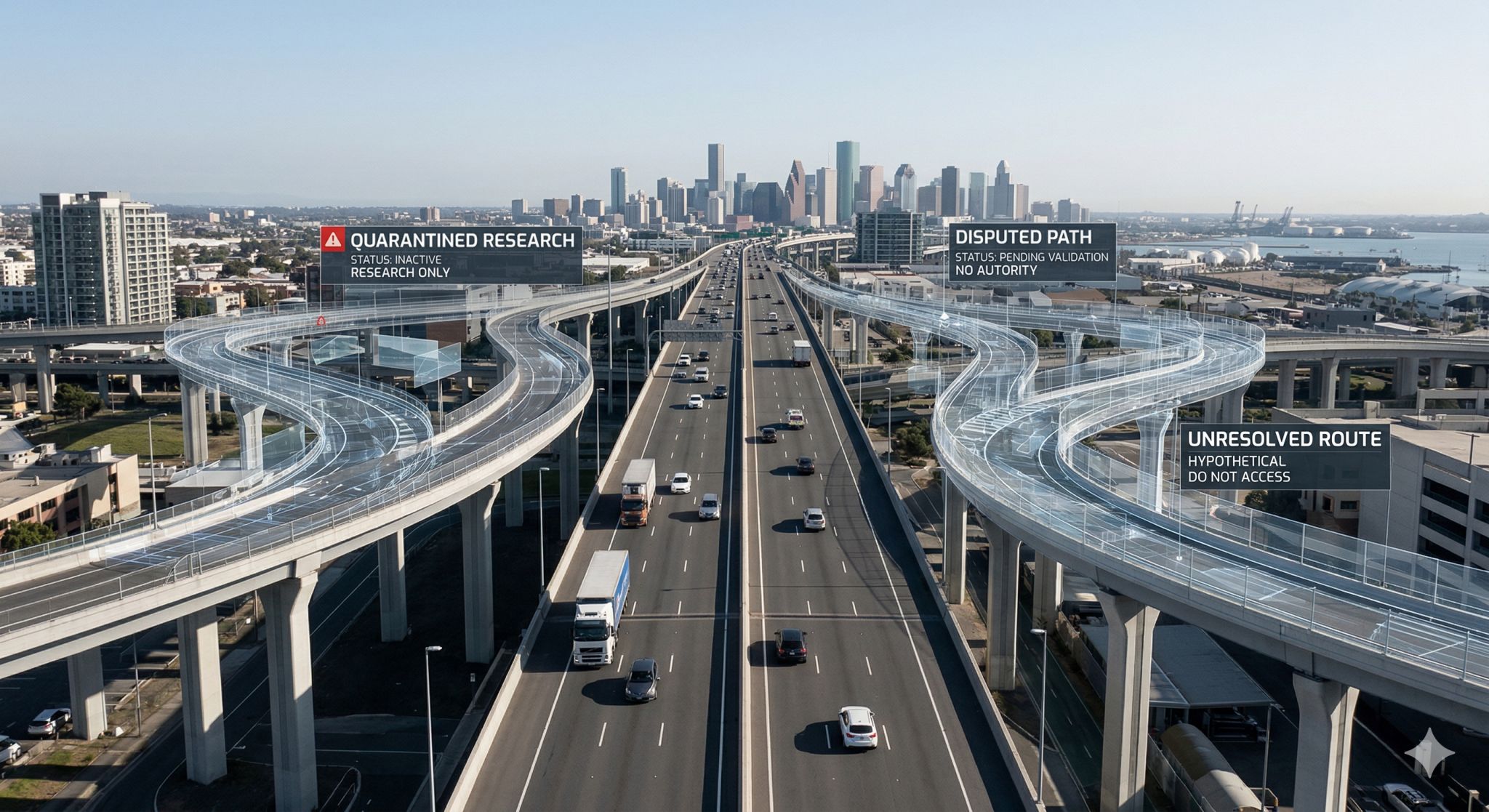
What interests me here is larger than one stack.
The deeper question is this: what kind of architecture makes long-lived AI systems more honest over time?
My answer is increasingly simple:
not more eloquence, not more confidence, not more post-hoc explanation, but better treatment of irreversibility, interruption, and unresolved state.
That is also why this release sits next to my broader work on Advanced Global Intelligence, L4 constraints, witness-backed accountability, and long-lived digital entities.
For me, these are not separate themes.
They are the same architectural problem seen from different angles:
- how do we keep continuity without hallucinating legitimacy?
- how do we preserve blocked futures without promoting them into action?
- how do we show branches without laundering them into truth?
- how do we let systems remain capable without becoming structurally dishonest?
I do not think the future belongs to systems that merely speak well.
I think it belongs to systems that know the difference between:
- what happened
- what might have happened
- what is evidenced
- what is disputed
- and what is still not allowed to move
That may sound less glamorous than the usual AI narratives.
But in serious environments, glamour is cheap.
The expensive thing is honest continuity.
And that is what I am trying to build toward: systems that do not become trustworthy by promising perfection, but by making boundaries, failures, and re-entry conditions explicit.
That is slower work.
But slower work is sometimes the only kind that scales without decay.
Related framing layer: https://lnkd.in/g9Yu-s6K