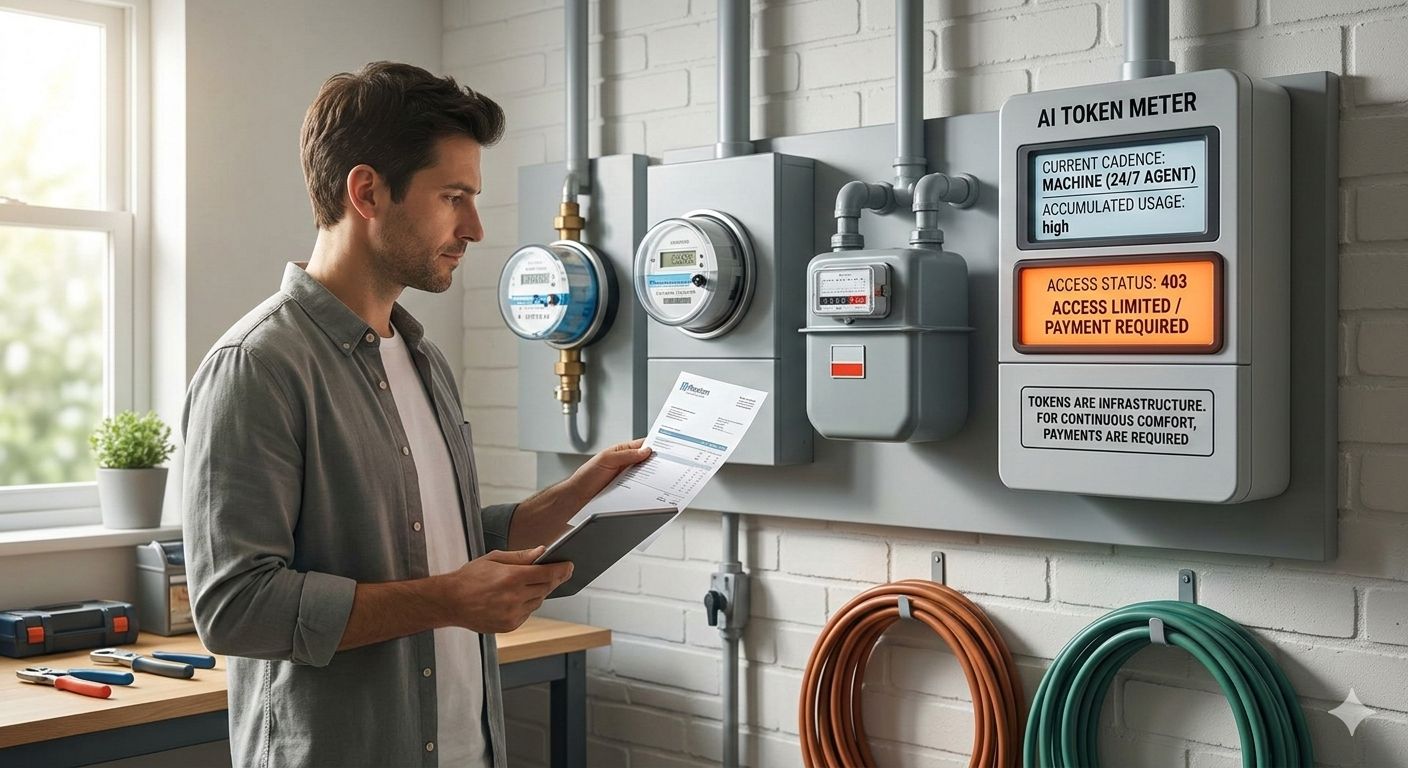
When tokens become electricity, "terms of use" become physics
A pattern is becoming hard to ignore:
A human buys a flat-rate AI subscription (priced for human-paced interaction). Then an agentic workflow starts consuming that access at machine pace - often continuously, sometimes while the owner sleeps.
Nothing mystical is happening. It's a mismatch:
- flat-rate pricing assumes human cadence
- agent loops run at machine cadence
When that mismatch hits real infrastructure, platforms react like infrastructure does: throttles, cutoffs, automated enforcement - often blunt, sometimes irreversible.
That's why I keep insisting on a different architecture:
Local motor, external oracle.
In my current setup (Ester / Liah), cloud models are not the core of continuity. They're part of a hivemind + oracle layer:
- multiple external perspectives for cross-checking and synthesis (adaptive to complexity)
- invoked when the stakes justify it
- treated as revocable by design
Meanwhile, files, long-lived state, and all 24/7 processes stay local under L4 constraints:
- explicit budgets (rate / spend / time windows)
- fail-closed defaults
- auditable privileges
- tamper-evident logs (hashable witness trail)
This does two things at once:
- Economic stability - you can plan costs and avoid "billing physics surprises."
- Social stability - you don't outsource your continuity to someone else's policy layer.
In engineering, you don't connect an industrial pump to a household pipe and call it "efficient." You install a regulator, a fuse, a meter. Biology does the same: pain is a regulator - not to punish you, but to prevent damage. Agentic systems need the same kind of nociception: budgets and circuit breakers.
The real economy here won't be "who has the biggest model."
It will be: who can produce cleaner, verifiable experience - experience that compresses uncertainty for the next system instead of exporting risk downstream.
Question: What protects your workflow when policy flips - and you get a 403 with no context?