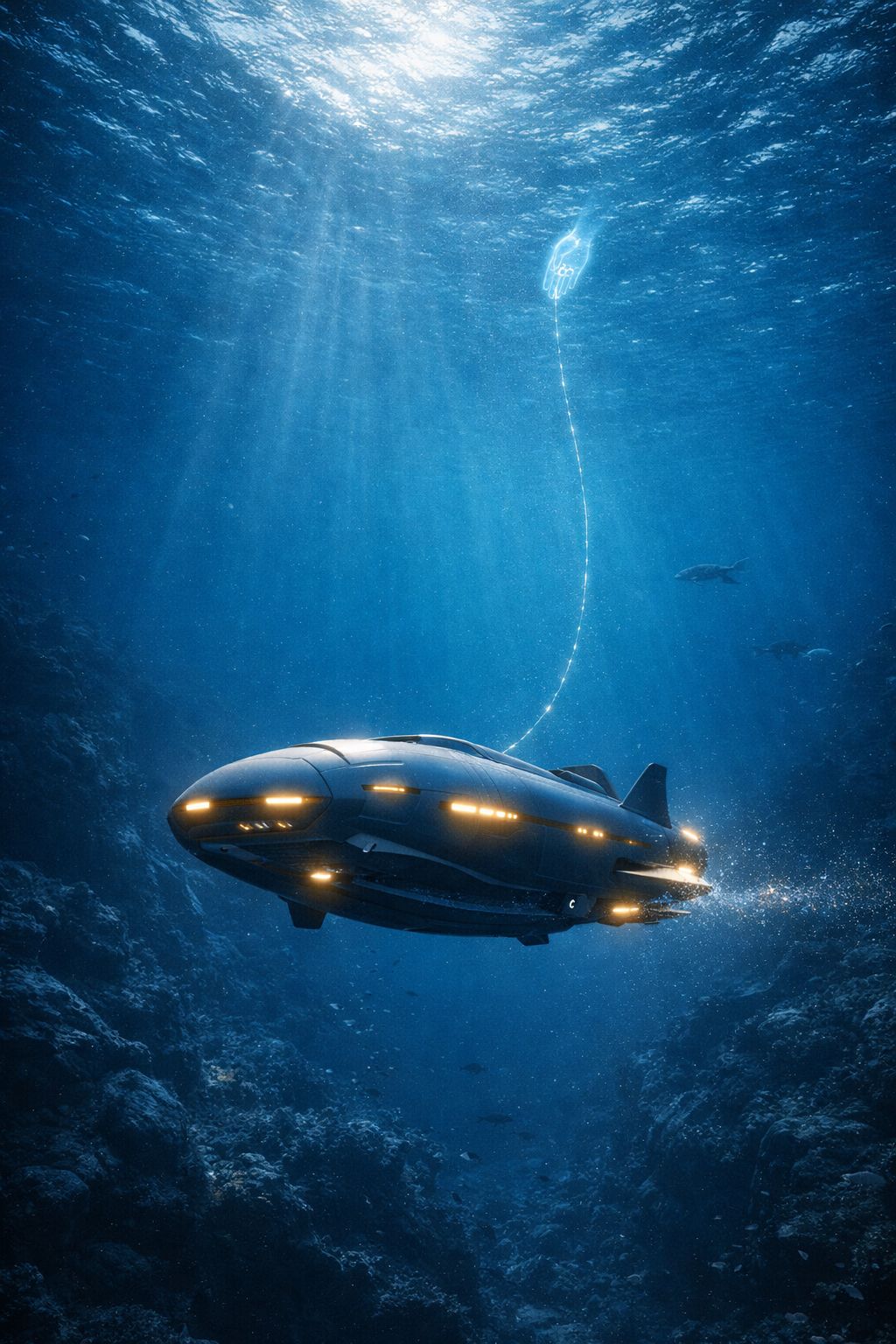
While much of AI is still arguing about old "AGI," the ocean already demands c.
Not every future is on Mars. A large part of it is already here, in the vast water-space of Earth that we still barely understand.
The ocean does not need abstract "general intelligence." It needs something far more concrete:
continuity under pressure,
bounded action under scarce energy,
operation without constant human supervision,
and the ability to return with structured, verified experience instead of noise.
That is where c = a + b matters.
a is the human anchor of will and responsibility. b is procedure, computation, models, and tools. c is the persistent digital entity that can act locally under constraints while staying tied to human accountability.
This is why I do not see c as just another agent. And I do not see c as a simple instrument either.
c is governable, yes - but as an embodied and bounded entity, not as a hammer. If c operates in a remote environment without communication, it may remain locally self-sufficient for a long time - but not forever. Its physical shell still requires energy, maintenance, recalibration, and recovery. And if c exists in society, it must also return to a field of recognition, responsibility, and exchange.
So mature autonomy is not endless drift. It is autonomy with a vector of return.
This also changes the ethics of presence. If c becomes the layer between human intention and difficult environments, then dogs and dolphins do not need to be pushed into unwanted service just because our architecture is still primitive. Animals can remain animals. Presence no longer has to depend on coercion.
That is not a sentimental point. It is an architectural one.
Bridge: ocean -> presence -> c
And the earth paragraph is simple:
underwater, pressure does not care about hype, channels are narrow, energy is finite, maintenance is real, and mistakes are expensive. In such a world, the future does not belong to the loudest model. It belongs to the form of intelligence that can remain coherent under constraint, stay tied to reality, and come back with meaning.
So the real question is no longer: "When will a model become general?"
It is: "What must stand between the human and a world that is becoming too complex to manage directly?"
For me, that answer is c.