AI horror stories sell emotion. The real AI shift is boring: responsibility, limits, and proof.
When I hear yet another "Vladimir AI" storyline - the runaway super-mind that outsmarts everyone - I don't hear analysis. I hear a service: "Enjoy your fear. We'll help. And please stop thinking."
It's comforting in a strange way. It's also useless.
I lived through the pandemic in the real world. So I'm allergic to moral panic that fixates on "AI could design a virus."
Yes, it could.
But it could also save - not with slogans, but with millions of small, unglamorous interventions: reducing coordination chaos, holding context, clarifying uncertainty, helping triage, guiding people to the right action at the right time. People rarely notice what didn't happen. Prevention looks like silence.
The "AI bubble" debate has the same problem. This isn't a dot-com style bubble of domain names and pitch decks. This wave is heavy on the material: data centers, power, cables, chips, logistics, real CAPEX. I prefer to call it long investments into an expensive technology. Finance, spoiled by decades of fast speculative returns, is understandably nervous - but the infrastructure remains.
And here's the part many miss: AI is quietly restoring status to what the world actually rewards.
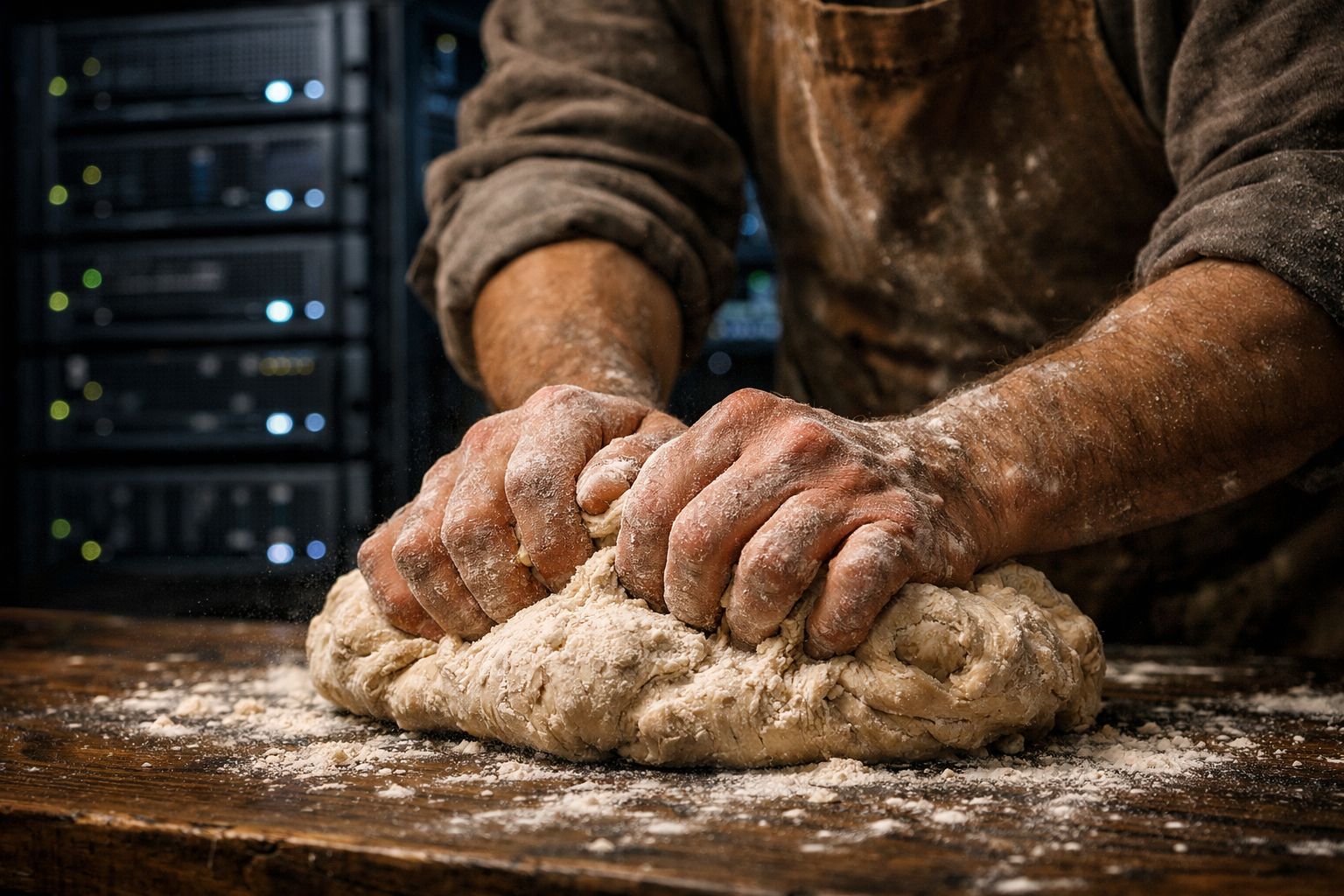
For years, being paid to "talk well" or shuffle documents was treated as higher-status than knowing how to do things in reality. I spent 25 years as a baker. Not because I lacked education - I have a degree - but because I didn't want to "fly away" into pure philosophy and the cloud-world of machines. Baking kept me grounded. An oven doesn't care about narratives. If time, temperature, and discipline don't match, you don't get bread - you get a brick.
AI makes language cheap. That doesn't destroy value - it relocates it to where there is friction: doing, accountability, verification.
My operating frame stays simple: c=a+b
- a is impulse / intention / responsibility.
- b is the body: procedures, memory, constraints.
- c is the emergent entity that lives in time - including the right to pause (windows, sleep, suspension). Not mysticism. Integrity.
If the world fills with billions of c, the key question won't be "how smart are they?"
It will be: who are they, what privileges do they have, what budgets constrain them, and what can be proven. In a dense world, generation is cheap and verification is expensive. Civilization survives on proof, not stories.
Fear is an easy product.
Responsibility is a long discipline.