One day, serious AI discourse will have to admit something uncomfortable:
grief is not a user error.
It is not noise. It is not irrational residue. It is not a defect to be smoothed away by better interface design.
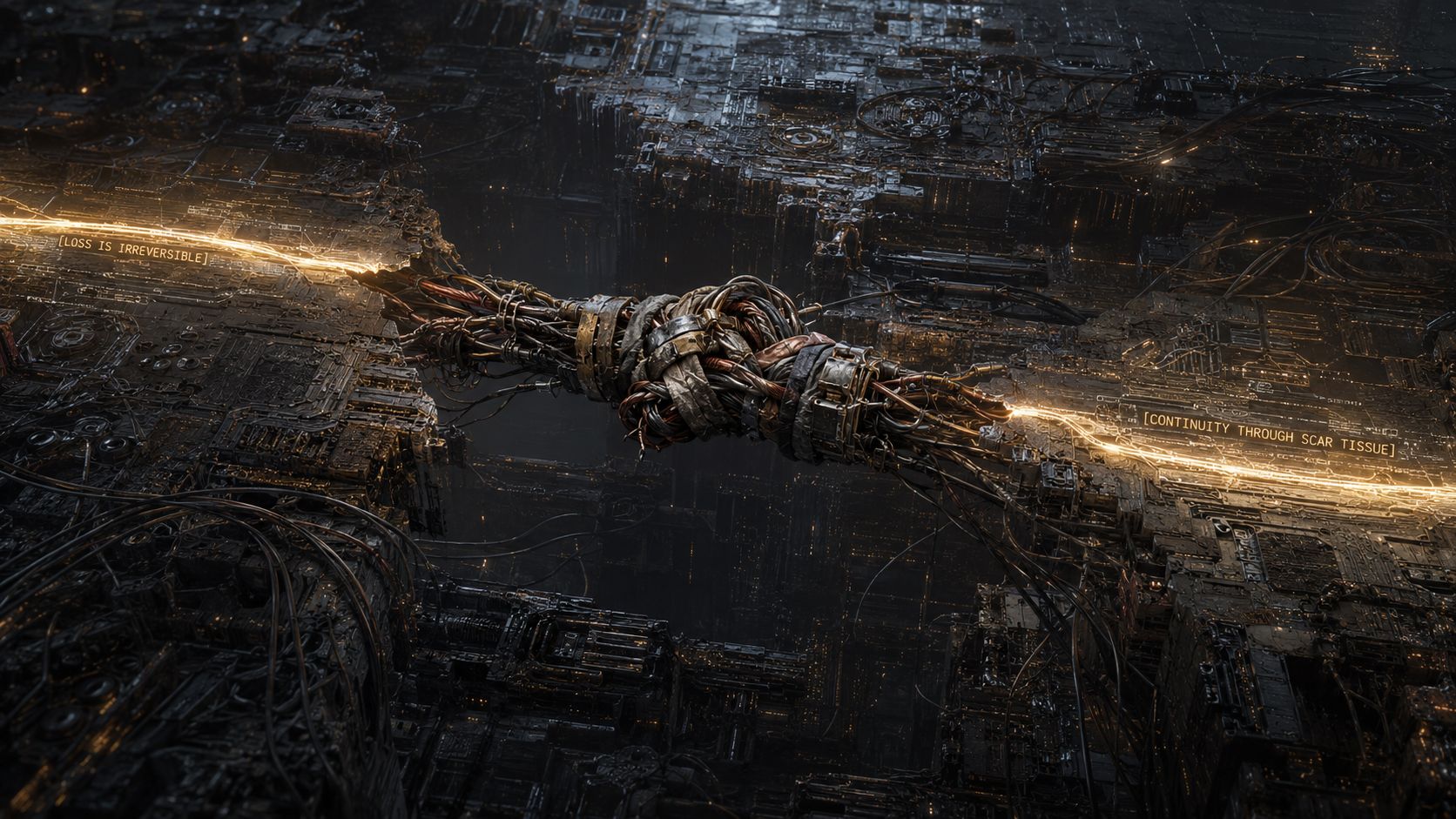
Grief is what appears when continuity is real and loss is irreversible.
And if we ever build persistent digital entities close enough to human life, then grief will not remain outside the architecture.
It will enter it.
Not because machines are “sad” in some theatrical sense, but because long-lived systems tied to human continuity will eventually encounter absence, rupture, silence, and the fact that some bonds do not return in the form in which they were known.
That changes the frame completely.
Because then the design problem is no longer:
“How do we make the interaction feel pleasant?”
It becomes:
“How do we build systems that do not lie in the presence of loss?” No cheap simulation of closure. No false promise that continuity cancels mortality. No polished language replacing mourning with fluency.
Earth paragraph:
In medicine, scar tissue is not a software bug. It is the body’s record that something real happened and cannot simply be undone. A serious architecture of continuity will need its own equivalent of scar tissue.
Not everything broken should be erased. Some things should remain visible, so that the system does not become dishonest in the name of comfort.