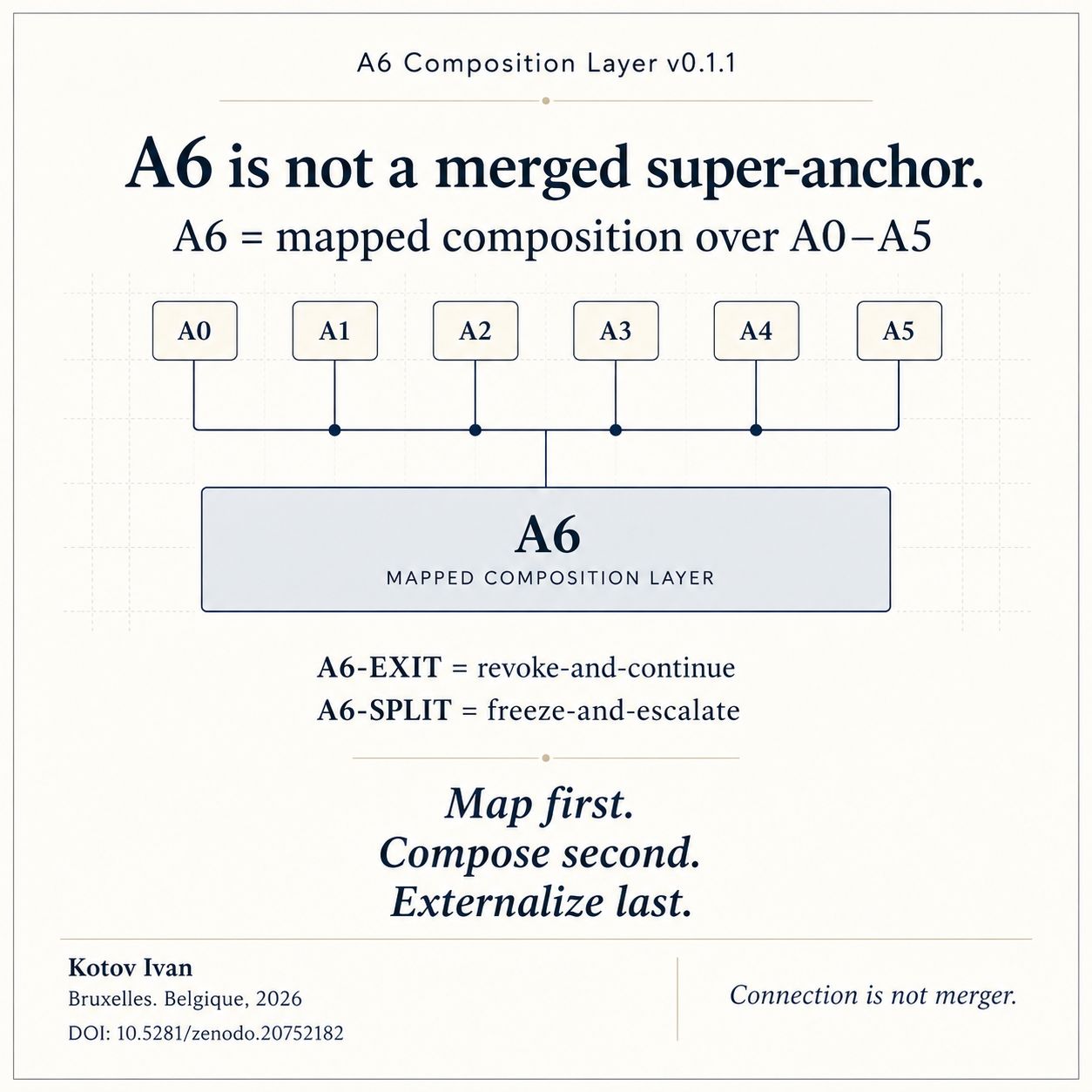
A small boundary question kept returning to the Project Ester corpus:
When several anchors meet, do they become one?
A human plus an organization. A family plus a business. A clinical network. A cross-border research project. A robot fleet inside an institution.
Technically, these can all be connected. But connection is not merger.
That is the reason for A6 Composition Layer v0.1.1.
A6 is not a merged super-anchor. A6 is a mapped composition over A0-A5.
This distinction matters because shared infrastructure can easily be mistaken for shared authority. Shared memory can be mistaken for shared identity. A shared dashboard can be mistaken for a single accountable subject.
The protocol keeps the boundary sober:
A6-EXIT = revoke-and-continue. A6-SPLIT = freeze-and-escalate.
One participant leaving should not automatically freeze the whole composition. But when the composition itself breaks, externalization must stop and review must begin.
The deeper rule is simple:
Map first. Compose second. Externalize last.
It is not glamorous. It is closer to plumbing, anatomy, and civil engineering than to mythology. But that is exactly the point. If a system can remember, act, delegate, and cross jurisdictions, then the boring maps become the safety layer: standing, authority, memory compartments, sensors, jurisdiction, Experience Artifacts, resources, custody, revocation, and witness.
Without those maps, federation becomes fog.
With them, composition can remain bounded.
Public page:
https://ivankotov.eu/publications/a6-composition-layer-v0-1-1/
DOI:
https://zenodo.org/records/20752182
Zenodo:
https://zenodo.org/records/20752182
GitHub release:
https://github.com/Kot141078/advanced-global-intelligence/releases/tag/a6-composition-layer-v0.1.1
Source package: