Current state
Start here
What is public now, what is implemented, what remains unproven, and where the current evidence boundaries sit.
Open current-state routePublic development timeline
A dated route from agentic task execution to c as the continuity-bearing layer above replaceable models, agents, tools, and swarms.
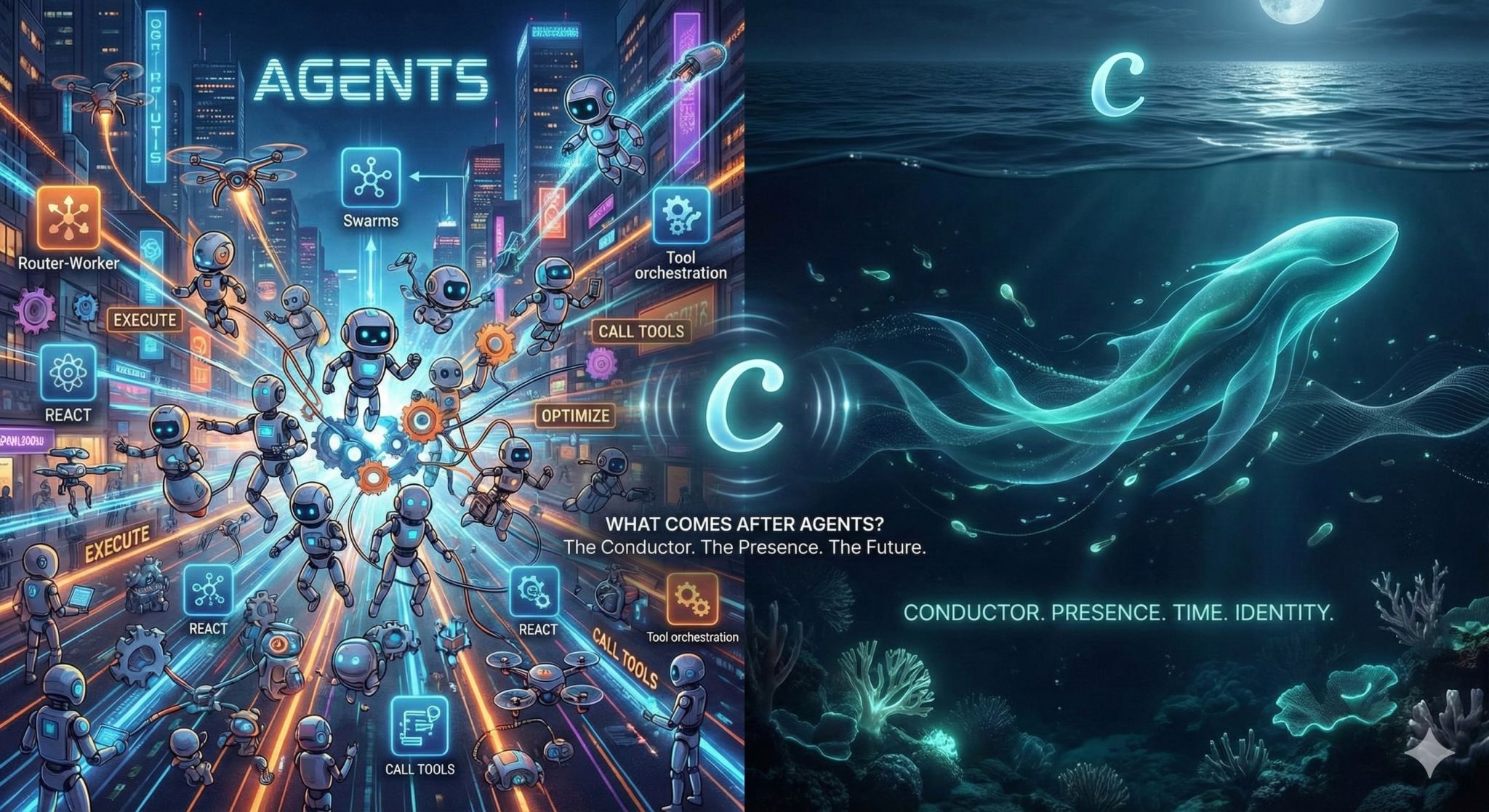
A model computes. An agent executes. A
ccontinues.
This page does not introduce another protocol. It records how one public question developed over time:
If agents are workers, what preserves identity, intent, memory, authority boundaries, and consequence when the workers change?
The answer proposed across this corpus is not a larger agent, a super-agent, or a swarm promoted into a subject. It is a different architectural layer: c.
Page role
The site already has a current-state map, a future-facing vision, and a complete diary. None of those surfaces provides this narrow dated lineage.
Current state
What is public now, what is implemented, what remains unproven, and where the current evidence boundaries sit.
Open current-state routeDirection
The future-facing authorial layer: what is likely, what is worth building, and how models, agents, and c are distinguished.
Full record
The complete public stream: technical releases, arguments, corrections, images, practical work, and changes in language.
Open archiveNarrow lineage
The shortest dated route through one specific transition: from agentic execution to continuity-bearing presence and governed evidence.
Follow the timelinePublic chronology
These are selected public turning points, not every post that contributed to the idea.
The first threshold moved away from fluency and raw capability toward restraint, consequential memory, non-dominating opinion, and the ability not to react.
The question was stated directly. Agents are doers. They answer how. What is missing is not another agent, but a conductor capable of holding when, why, whether, identity, and continuity.
The distinction was grounded operationally: continuity, cost, verified identity, bounded privileges, and a witness trail that survives prompts.
The worker/subject split became explicit. Agents, judges, tools, and models may multiply or rotate. Continuity belongs to c, not to the swarm.
c as a temporal entity of AI presenceA public name was fixed for the class: a tool is invoked, an agent executes, but a c remains through memory, bounded presence, internal rhythm, reinterpretation, and sustained relation under real constraints.
The distinction became implementation-facing. Executable agents could inspect, patch, test, compare, and report — while memory, witness, rollback, release authority, and human stop paths remained outside the worker role.
c was applied to real work: not as another autonomous worker, but as an agentic operating layer around a living human anchor who carries body, risk, law, professional context, and consequence.
The unit of value shifted from one answer to sustained presence: local memory, background processing, multiple model roles, private context, low latency, and a physical place where continuity can remain.
Scaling autonomous workflows without continuity, memory gates, witness separation, and resource accountability was framed as a staircase to nowhere. More execution does not create a subject.
The question moved beyond internal consistency. Cleanroom ARM-P and the Project Ester evidence work made controlled evidence export, custody, deterministic replay, state transitions, and claim boundaries part of the public test surface.
cThe concise distinction entered the site's future-facing authorial layer: a model computes, an agent executes, and a c continues as a causally connected trajectory through time.
The argument became a complete multilingual book: World Intelligence: Humans, c, and Temporal AI Presence Beyond the Age of Agents. The book is synthesis and narrative access — not evidence authority.
Structural shift
The central object stopped being the answer and became the sequence a system can carry without losing its identity or claim boundaries.
More agents increase capability. They do not automatically create continuity, standing, responsibility, or a lawful center of action.
Stored text is not enough. Memory matters when it changes future behavior while preserving provenance, uncertainty, and the right to challenge.
A worker may be capable of acting without being authorized to own memory, promote experience, change identity, or release a result.
Persistent intelligence needs power, cooling, local memory, maintenance, budgets, shutdown paths, and a place where time is real.
Public language became progressively more constrained by witness, deterministic checks, migration tests, non-claims, and falsifiable boundaries.
Claim boundary
It establishes a dated public development route inside Ivan Kotov's authored corpus. It helps readers inspect when distinctions appeared, how they changed, and where they were later formalized.
It does not establish priority over every similar idea, independent validation, consciousness, personhood, entity status, production safety, deployment authorization, or that every persistent AI system is a c.
Diary posts and Vision provide authorial and developmental context. DOI-bound publications, tagged repositories, manifests, checksums, tests, and explicitly named evidence packages retain their own stated authority and non-claim boundaries.
Continue